
The Waqf Board declared Taj Mahal as its property on July 13.

The bench on October 16 had reserved the judgment after marathon hearing of 40 days.
A five-judge Constitution bench headed by Chief Justice of India Ranjan Gogoi, which started the day-to-day proceedings on August 6 after mediation proceedings failed to find an amicable solution to the vexatious dispute, has revised the deadline for wrapping up the proceedings and has fixed it on October 17.
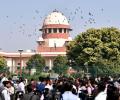
highlights of the Supreme Court judgment in which it unanimously granted the entire 2.77 acre of the disputed Ram Janambhoomi-Babri masjid land in Ayodhya to deity Ram Lalla.

While five pleas have been filed by Maulana Mufti Hasbullah, Moulana Mahfoozur Rehman, Mishbahuddin, Mohd Umar and Haji Nahboob, who are all supported by the All India Muslim Personal Law Board, the sixth one has been filed by Mohammad Ayub.

A 5-judge Constitution Bench headed by Chief Justice Ranjan Gogoi, in its historic verdict delivered on a court holiday, held that the lawsuit of the deity was "within the period of limitation" and granted the title decree in its favour.

The litigant, in review plea filed through lawyer Ejaz Maqbool, has also sought an interim stay on operation of the verdict in which it had directed the Centre that a trust be formed within three months for construction of the temple at the site.
 © 2026 Rediff.com - Advertise with us - Disclaimer - Privacy Policy - Sitemap - Feedback - About us - Terms of use - Grievances