
The US Fed's interest rate decision will be the major factor dictating trends in the domestic equity market this week, with global movements and foreign investor activity also influencing sentiment, according to analysts. Stock markets ended the last week on a subdued note, with benchmark indices Sensex and Nifty closing flat.

Gold prices dropped by Rs 4,100 to Rs 121,800 per 10 grams in the national capital and slipped below $4,000 an ounce in the global markets on Tuesday as easing US-China trade tensions dampened safe-haven appeal. According to the All India Sarafa Association, the precious metal had closed at Rs 125,900 per 10 grams on Monday.

Gold prices are expected to witness further consolidation in the coming week as investors brace for a slew of events, ranging from central bank meetings, including the US Federal Open Market Committee (FOMC) meeting's outcome, to global trade negotiations, analysts said.

The impact of the US Federal Reserve's move to cut the benchmark interest rate will be muted for India as it was mostly priced in, Chief Economic Advisor V Anantha Nageswaran said on Thursday. He said that the Indian stock market is already attracting investor interest and overall the rate cut is positive for emerging markets.

The US Fed rate cut of 50 basis points is unlikely to have any significant impact on foreign inflows into India, Economic Affairs Secretary Ajay Seth said on Thursday. He said the US Federal Reserve has done what it assesses is good for the largest economy in the world, but the RBI will take a decision on interest rate cut keeping the Indian economy in mind. "It is a positive for the global economy, including the Indian economy. "It is a 50 basis points cut from a high level.

The US Federal Reserve's interest rate decision is the biggest event that would drive sentiments in the domestic stock market this week, besides a host of macroeconomic data from the global front and trading activity of foreign investors, analysts said. The Indian equity market had an exceptional last week, with both the Nifty and Sensex hitting their all-time high levels on Thursday.

Quarterly earnings from corporates, the US Fed interest rate decision and other global trends will be the major driving factors for determining movement in the domestic equity market in a holiday-shortened week ahead, analysts said. Besides, factors like trading activity of foreign investors, global oil benchmark Brent crude and rupee-dollar trend would also influence trading.
Indian stock markets are expected to be driven mostly by global factors this week amid a lack of local triggers and earnings season largely coming to an end, say analysts. Crude oil prices, rupee movement and US Federal Reserve meeting minutes to be released this week will also influence the market sentiment. "With the earnings season behind us, global cues would largely dictate the trend in the coming week," Ajit Mishra, SVP - technical research, Religare Broking Ltd, said.

Benchmark indices Sensex and Nifty ended with gains on Wednesday, extending the previous day rally amid lower level of inflation on domestic front and better-than-expected inflation readings from the US. The 30-share BSE Sensex climbed 144.61 points or 0.23 per cent to settle at 62,677.91. During the day, it jumped 301.81 points or 0.48 per cent to 62,835.11.

Among the Sensex firms, Bajaj Finserv, Tata Motors, Asian Paints, ITC, IndusInd Bank, State Bank of India, Tata Steel, Wipro, Infosys and Maruti were the major gainers. Tech Mahindra, HCL Technologies, Kotak Mahindra Bank, Titan and Larsen & Toubro were the major laggards.

Equity markets will be driven by the outcome of the US Federal Reserve's interest rate decision this week, analysts said. Moreover, equity benchmarks will also continue to be guided by foreign fund movement and trend in Brent crude oil, they added. "The global markets are looking nervous after the US inflation numbers, which have caused the dollar index to hover around 110," said Santosh Meena, head of research, Swastika Investmart Ltd. Now everyone is eyeing the outcome of the upcoming US Federal Open Market Committee (FOMC) meeting.

In the backdrop of an over four-decade high inflation, the US Federal Open Market Committee has raised its key policy interest rate by 75 basis points to 2.25-2.50 per cent, anticipating that the increase in the interest rates will be "appropriate". Hiking interest rates typically cool demand in the economy, thereby putting a brake on the inflation rate. The US Federal Reserve in its June meeting too raised the interest rate by 75 basis points, which was the steepest hike since 1994.
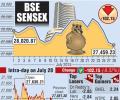
The BSE Sensex ended 102 points or 0.3% down at 27,459.

The market breadth was positive. Out of 2,519 stocks traded so far, 1,266 stocks advanced while 1,105 declined on the BSE.
China would contribute $41bn towards the pool. Brazil, India and Russia would contribute $18bn each; South Africa $5bn.
The cut is being seen as an emergency measure to boost the US economy.

The Rupee is likely to recover during day trad, say currency watchers.

The Indian rupee on Monday reacted downwards by 12 paise to log nearly one-week closing low of 63.41 against the Greenback.

The rupee rose by 4 paise at 66.88 against the US dollar in early trade on Wednesday.

The home currency failed to keep momentum going and largely traded in a narrow range with positive bias in the absence of any market moving factors

The rupee had recovered from its 29-month lows by rising 39 paise to close at 67.63 on Friday.

The markets are in bubble territory.

Kamath said India's economic climate had started improving.

A day after BRICS (Brazil, Russia, India, China and South Africa) nations agreed on a $100-billion foreign currency reserve pool to tackle the volatile foreign exchange markets, India on Friday said the pool would act as a buffer arrangement, adding it might not withdraw anything from this reserve.

The Indian stock market had rallied through the first fortnight of October but it gave back the bulk of its gains in the second half.

Over the past week, the Sensex and the Nifty continued the bull-run

The latest macro-data from India is disquieting
.jpg)
The broader markets traded positively with mid-caps and small-caps rising 0.5 per cent each on the BSE.

Managing Brexit, inflation and banking reforms, along with the political environment, will be tough.

The US FOMC concludes its two-day meeting today while the Bank of Japan will start its two-day meeting today.

The Bank Nifty is high beta anyhow and it could move the broader market.

"While the risk of a correction goes up in the near term, on a long-term basis the Indian market is on an absolutely strong footing."

The upcoming July derivatives expiry later in the week would also add some volatility to the market proceedings.

Food and fuel are two perennial areas of concern.
 © 2026 Rediff.com - Advertise with us - Disclaimer - Privacy Policy - Sitemap - Feedback - About us - Terms of use - Grievances