
The United States Trade Representative (USTR) office on Wednesday launched a sweeping investigation into manufacturing and industrial practices in 16 economies, including India, citing concerns over what it calls 'structural excess capacity' that could distort global trade. Announcing the move on a White House press call, Jamieson Greer said the probe would be conducted under Section 301 of the Trade Act of 1974, one of Washington, DC's most powerful trade enforcement tools.

Replacing over a third of India's oil imports at competitive rates is going to be a challenge, said traders from State refiners, even though some progress was made in the last two months.

Greer said that India has taken down some digital services taxes and is moving tariffs down.

The deal shifts the US posture towards India from hostile to neutral, and that matters for growth, points out T T Ram Mohan.
The US said India will lower tariffs on a "vast array" of American industrial and agricultural goods, such as "fruits, vegetables", to zero per cent under the trade deal announced by President Donald Trump.

New Delhi will substantially reduce tariffs on industrial and agricultural goods while continuing to protect sensitive sectors. Tariffs on some agricultural products that are not traditionally considered sensitive will be brought down to zero, while in the case of relatively sensitive items, duties will be reduced in a graded manner and quotas will be imposed.

Kwatra termed India's successful launch of an American communication satellite on Wednesday as a 'very important and big day' for partnership between Washington and New Delhi, saying it caps a series of achievements in 2025 in bilateral space cooperation between the countries.

'I don't think we should ever negotiate with deadlines or hard stops because we tend to make mistakes then.'

Reserve Bank of India (RBI) Governor Sanjay Malhotra, and Deputy Governors Poonam Gupta, T Rabi Sankar, Swaminathan J, and S C Murmu on Friday addressed issues during the post-policy media interaction.
A delegation led by Commerce and Industries Minister Piyush Goyal will visit the United States for trade talks on September 22, the commerce ministry said on Saturday.
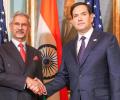
This will be the first face-to-face meeting between Rubio and Jaishankar following President Donald Trump's imposition of an additional 25 per cent tariff on India for Delhi's purchases of Russian oil, taking the total levies imposed on India by the Trump White House to 50 per cent.

Trump's post on Truth Social comes a day after the US asked G7 countries to impose tariffs on countries purchasing oil from Russia.

The decision to hike US H-1B visa application fee to $100,000, trade talks and the GST rate cut will be the key drivers for stock market movement this week, analysts said.
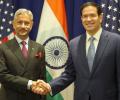
Rubio voiced "appreciation" for New Delhi's continued engagement on bilateral issues, including trade, defence and energy.

The statement did not name any country. But the US has often blamed India and China for purchasing Russian oil even when there are no tariffs on Beijing for it.
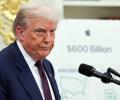
As one of the federal appeal courts in the United States ruled that most of tariffs imposed by Trump administration are not accordance with the laws, US President Donald Trump on Friday (local time) affirmed that all tariffs imposed on the countries will remain in effect, calling a recent ruling by a 'highly Partisan Appeals Court' incorrect.

Brazilian President Luiz Inacio Lula da Silva on Wednesday (local time) issued a firm response to United States President Donald Trump's announcement of a 50 per cent tariff on Brazil by invoking the country's 'Economic Reciprocity Law', while asserting Brazil's sovereignty and rejecting 'any form of tutelage' in what he described as Trump's attempts to interfere in the country's internal judicial affairs.
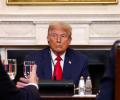
United States President Donald Trump announced a 50 per cent tariff on imports from Brazil, starting August 1, and called the trial of former Brazilian President Jair Bolsonaro a 'witch hunt', adding that the 'trial should not take place'.

Tata Motors is hoping to beat its target year of 2030 and have 30 per cent of its portfolio comprising electric vehicles (EVs), according to Chairman N Chandrasekaran, who was speaking at the company's last annual general meeting (AGM) ahead if its demerger.
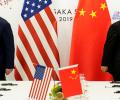
The call lasted approximately one and a half hours, and resulted in a very positive conclusion for both countries.
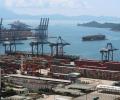
India's major imports from the US include crude oil and petroleum products, gold and jewellery, plastics, aircraft, and electrical machinery and components. The key exports to the US comprise pharmaceuticals and biologicals, telecom equipment, precious and semi-precious stones, petroleum products, gold and precious metal jewellery, and ready-made garments.
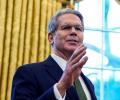
As in-person negotiations between India and the US kickstarted on Wednesday, Treasury Secretary Scott Bessent said he expected India to strike the first bilateral trade deal to avert President Donald Trump's reciprocal tariffs.

LIC said USTR's views are based on an incomplete understanding of Indian insurance regulation and LIC's functioning.
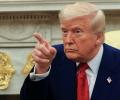
Trump's sweeping tariffs and penalties on China-built ships have turned global shipping into the front line of economic war, observes Shyam G Menon.
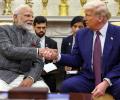
'I certainly hope the two can avoid a trade war and believe they will.' 'I expect some in India will push for retaliatory tariffs if the Trump administration applies significant reciprocal tariffs.'
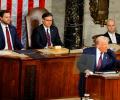
I'...additional concessions, such as opening government procurement, reducing agricultural subsidies, weakening patent protections, and allowing unrestricted data flows -- demands India has resisted for decades.'
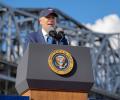
On Friday, Biden announced his intent to appoint 14 people to the advisory committee, which provides overall policy advice to the United States trade representative on matters of development, implementation, and administration of the US trade policy.

In a major development, India and the US have agreed to end six trade disputes at the WTO through mutually agreed solutions, while New Delhi will remove retaliatory customs duties on certain American products such as almonds, walnuts, and apples.
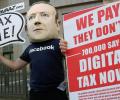
The US on Wednesday announced tariffs on six countries, including India, that have imposed or are considering equalisation levy/digital services tax on e-commerce companies but immediately suspended the taxes for up to six months to provide additional time to complete the ongoing multilateral negotiations on international taxation at the OECD and G20. United States Trade Representative (USTR) Katherine Tai, in a statement, announced the conclusion of the one-year Section 301 investigations of Digital Service Taxes (DSTs) adopted by Austria, India, Italy, Spain, Turkey and the UK. "The final determination in those investigations is to impose additional tariffs on certain goods from these countries, while suspending the tariffs for up to 180 days to provide additional time to complete the ongoing multilateral negotiations on international taxation at the OECD and in the G20 process," the statement said.
New Delhi and Washington have agreed to count the benefits of a global agreement on taxation from the next financial year. However, the benefits would actually accrue once the global pact comes into effect or March 31, 2024, whichever is earlier, in the form of credit.
In January last year, the US signed the first phase of the trade deal with China, which former President Donald Trump described as historic, concluding more than a year of tough negotiations including several months of suspension of talks between the two largest economies of the world.

The government said that far from targeting any US entity, the purpose was to ensure fairness, healthy competition, and to exercise the ability of governments to tax businesses having a nexus with the Indian market through digital operations.
India has demanded resumption of export benefits to certain domestic products under GSP, and greater market access for its products from sectors like agriculture, automobile, auto components and engineering. On the other hand, the US wants greater market access for its farm and manufacturing products, dairy items and medical devices, data localisation, and import duties cut on some ICT products.
A total of Rs 396 crore has been mopped up, as on August 20 against Rs 407 crore collected in the same period last year. This was despite the expansion of the levy to online e-commerce players from this financial year.
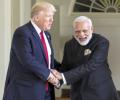
The trade deal, officials say, can lead to an effective trading bloc against the China-led Regional Comprehensive Economic Partnership.

The two leaders also took positive note of the growing bilateral cooperation in defence, counter-terrorism and energy, besides the co-ordination on regional and global issues, the officials said.

Communications between the USTR and the world's most powerful pharmaceutical and trade lobbying groups reveal that many raised concerns about India's push to exempt Covid vaccines from intellectual property.

USTR has said India imposed several barriers in major services industries such as insurance, banking, audiovisual, accounting, legal, telecommunications, distribution services, postal and express delivery services.

It also sought permanent exemption from the requirements that wine and distilled spirits labels include an ingredients list and disclose the date the product was manufactured.

The top Obama Administration official said the US will negotiate agreements that commit its trading partners to protecting American intellectual property, such as the Anti-Counterfeiting Trade Agreement and the Trans-Pacific Partnership.
 © 2026 Rediff.com - Advertise with us - Disclaimer - Privacy Policy - Sitemap - Feedback - About us - Terms of use - Grievances