
Researchers at IIT Mandi have developed a real-time landslide monitoring and early warning system that has been deployed in landslide-prone areas of Mandi district, Himachal Pradesh. The system uses machine learning and sensors to detect ground movements and provide early warnings to authorities and the public.

'Today, as I look at our satellite -- tested, finished and ready to ship -- represents 1,642 days of grit and belief.'

Based on the broadcast visuals, a rocket expert said the failure appeared similar to the anomaly seen during the PSLV-C61 mission.

These upcoming launches carry added significance in light of setbacks suffered in recent years.

'A solid motor, once ignited, burns until the propellant is exhausted. It cannot simply stop mid-burn,' said a retired senior ISRO official. 'That is what makes this failure puzzling.' Venkatachari Jagannathan reports on the latest PSLV failure.
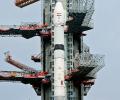
The main focus of the all weather RISAT-1B satellite will be to observe the Indian land with its C-band synthetic aperture radar.

The private consortium would invest more than Rs 1,200 crore over the next five years to launch a constellation of 12 state-of-the-art Earth Observation satellites equipped with panchromatic, multispectral, hyperspectral, and microwave SAR (synthetic aperture radar) sensors.
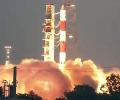
ISRO chairman announces plans for nine major launches by the end of the fiscal year, including the Blue Bird Block2 communication satellite for the US in collaboration with NASA.
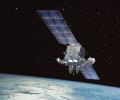
Pixxel has raised $95 million in funding and with the company's commercial Firefly satellites up in orbit selling data globally 'we know and seen what it takes to make this business work.'
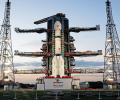
The imaging technology in Nisar can provide very high-resolution data on changes as small as one centimetre in size on the earth's surface.

India and the US on Wednesday marked their maiden space collaboration with the successful flight of a GSLV rocket that placed an earth observation satellite, jointly developed by the two space agencies, in a precise orbit.

Twice every 12 days, the NISAR satellite will scan nearly all of earth's land and ice surfaces to measure changes in the planet's ecosystems, growth and retreat of its land and sea ice, and deformation of its crust.

ISRO to launch a 6,500 kg communication satellite built by the US, marking a significant milestone in the Indian space program after the successful launch of the NASA-ISRO NISAR mission.
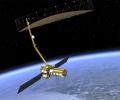
NISAR will not be used for surveillance and will be used to observe the earth.

Indian Space Research Organisation's 101st mission from Sriharikota, an earth observation satellite onboard the agency's trusted Polar Satellite Launch Vehicle (PSLV) rocket, could not be accomplished on Sunday following a pressure issue in the third stage of the launch vehicle, the space agency said.

IIT Kanpur has announced a breakthrough in stealth technology, which would make tanks and fighter aircraft invisible, or near-invisible to enemy radar.
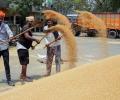
ISRO has projected wheat production of 122.24 million tonnes.
'There's too much coincidence in back-to-back failures of missions critical to national security.'
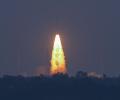
A PSLV rocket carrying Earth observation satellite EOS-09 failed to launch from the Sriharikota spaceport early on Sunday.
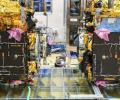
Demonstration of seed germination in outer space, a robotic arm to catch a tethered debris there, and testing of green propulsion systems are some of the experiments planned on the POEM-4 -- the fourth stage of ISRO's PSLV rocket that remains in orbit after launching a satellite.

The US Air Force on Wednesday handed over NISAR, an earth observation satellite jointly developed by NASA and ISRO, to the Indian space agency.
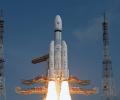
A mission to study the Sun, and launching a climate observation satellite, a test vehicle as part of Gaganyaan human space flight programme and an Indo-US synthetic aperture radar.
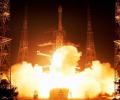
ISRO is part of an exclusive league which has forayed into the Moon and Sun.

The primary satellite TeLEOS-2 is a synthetic aperture radar satellite developed under partnership between Defence Science and Technology Agency (DSTA) representing the Government of Singapore and ST Engineering.

Scientists are working on conducting various tests for the ambitious Gaganyaan mission and the agency is coordinating with the Navy and others in this connection, he said.

Once deployed and operational, it will be used to support the satellite imagery requirements of various agencies within the government of Singapore.

'With India's growing capabilities in the space sector, this creates promising opportunities for enhanced collaboration and market access.'

'Techfest', an annual science and technology event organised by the Indian Institute of Technology Bombay in Mumbai.

The PSInSAR satellite technique used to observe the gradual sinking of Uttarakhand's Joshimath town is a powerful remote sensing tool capable of measuring and monitoring displacements in the Earth's surface over time.

ISRO chairman S Somanath said the success gave the space agency "greater confidence," as the GSLV will be next deployed in the NISAR mission, a collaborative effort with the US' NASA.

The American agency said the data from the two instruments Mineralogy Mapper and Miniature Synthetic Aperture Radar (Mini-SAR) will contribute to its understanding of the lunar environment and are part of its implementation of its space exploration policy which calls for robotic and human missions to the moon.
"By triangulation, we have located the area which is about 5-km radius circle and it has been identified based on the last contact with the air traffic control," Chavan, Union minister of state in the Prime Minister's Office, told reporters
Scientists have detected more than 40 ice-filled craters in the moon's North Pole using data from a NASA radar that flew aboard India's Chandrayaan-I. NASA's Mini-SAR instrument, lightweight, synthetic aperture radar, found more than 40 small craters with water ice. The craters range in size from 2 to 15 km in diameter.
Israel's defense forces will this week launch its most advanced satellite -- on the back of an Indian space mission.
It will be the first time that Israel will launch a satellite aboard an Indian rocket.
two US scientific instruments will be on board India's mission to the Moon 'Chandrayaan-1'.

After sending missions to the Moon and Mars, ISRO is now readying a spacecraft to orbit Venus to study what lies below the surface of the hottest planet in the solar system and also unravel the mysteries under the sulfuric acid clouds enveloping it.
The two US payloads are -Mini Synthetic Aperture Radar and Moon Mineralogy Mapper.
India on Monday successfully launched Israeli satellite 'Polaris' from the Satish Dhawan Space Centre in Sriharikota by a homegrown Polar Satellite Launch Vehicle, a spokesman of the Indian Space Research Organisation said. This is the second time that a 'core alone' PSLV configuration had put a satellite into orbit. In April 2007, an Italian satellite Agile was put into the orbit, the space agency spokesman said.
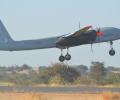
Rustom 2 is being developed on the lines of predator drones of the United States to carry out surveillance and reconnaissance roles for the armed forces with an endurance of 24 hours, officials said.
 © 2026 Rediff.com - Investor Information - Advertise with us - Disclaimer - Privacy Policy - Sitemap - Feedback - About us - Terms of use - Grievances