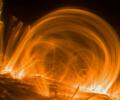
The breakthrough reveals the dazzling world of miniature plasma loops, or tiny loops, which stretch almost as long as the distance between Kashmir and Kanyakumari.The breakthrough reveals the dazzling world of miniature plasma loops, or tiny loops, which stretch almost as long as the distance between Kashmir and Kanyakumari.

XPoSat or X-ray Polarimeter Satellite is India's first dedicated polarimetry mission to study various dynamics of bright astronomical X-ray sources in extreme conditions.

The initial assessment of the first-ever measurements of the near-surface lunar plasma environment over the south pole region by RAMBHA-LP payload onboard Chandrayaan-3 lander indicates that plasma there is relatively sparse, ISRO said on Thursday.

Its duties include experiments to further understand the lunar surface.

A satellite placed in the halo orbit around the first Lagrangian point (L1) of the Sun-Earth system has the major advantage of continuously viewing the Sun without any occultation/eclipses, the IIA said.

The Laser-Induced Breakdown Spectroscope instrument onboard 'Pragyan' rover of Chandrayaan-3 has 'unambiguously confirmed the presence of sulphur in the lunar surface near south pole, through first-ever in-situ measurements,' ISRO said on Tuesday.
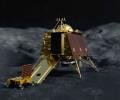
The Lander and the Rover have scientific payloads to carry out experiments on the lunar surface. The main function of the Propulsion Module (PM) was to carry the Lander Module (LM) from the launch vehicle injection till final lunar 100 km circular polar orbit and separate the LM from PM, which it did.

Chandrayaan-3 mission's rover 'Pragyan' has traversed a distance of about eight metres on the lunar surface, and its payloads have been turned on, ISRO said on Friday.

After the successful deployment of Chandrayaan-3's lander and rover on the moon, Indian Space Research Organisation (ISRO) is hoping that their mission life will not be limited to one lunar day or 14 earth days, and that they will come back to life when the sun again rises on the Moon, to carry on with the experiments and studies there.
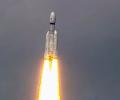
The Chandrayaan-3 mission that aims for a soft landing on the moon's surface, paving the way for future interplanetary missions, carries six payloads that would help ISRO understand the lunar soil and also get the blue planet's photographs from the lunar orbit.

Announcing that the health of Chandrayaan-3's Lander Module is normal, ISRO on Friday said that the module has successfully undergone a deboosting (slowing down) operation, taking it closer to the Moon.

Friday's mission is the fourth operational flight of LVM3 which aims to launch the Chandrayaan-3 spacecraft into a Geo Transfer Orbit.

Lander Module of Chandrayaan-3 spacecraft comprising the lander and rover has successfully separated from the Propulsion Module, Indian Space Research Organisation said on Thursday.

The rover will carry out in-situ chemical analysis of the lunar surface during the course of its mobility.

Four years after it broke many hearts, Indian Space Research Organisation's Chandrayaan is all set to soar towards the moon in its third expedition on Friday in an attempt to put the country in an elite club of nations that accomplished lunar missions with a soft landing.

India will become the fourth country to master the technology of soft-landing on the lunar surface after the US, China and the erstwhile Soviet Union.

Chandrayaan 3 follows the Chandrayaan 2 mission which did not achieve the desired soft landing on the surface of the moon in 2019, disappointing the scientists.

The entire process being autonomous when the lander has to fire its engines at the right times and altitudes, use the right amount of fuel, and scan of the lunar surface for any obstacles or hills or craters before finally touching down.

Planetary scientists claim that the Hubble telescope has found hints of "building blocks of life" on Pluto.
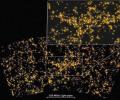
This is one of the largest known structures in the neighbourhood of the universe, 4,000 million light-years away from Earth and roughly more than 10 billion years old, IUCAA said.

'Our technology is going to help Indian agriculture the way the White Revolution helped milk production.'
 © 2026 Rediff.com - Investor Information - Advertise with us - Disclaimer - Privacy Policy - Sitemap - Feedback - About us - Terms of use - Grievances