
The National Health Protection Scheme -- announced by the finance minister -- is aimed at benefiting 10 crore poor families by providing coverage of up to Rs 5 lakh per family per year.

The states fear they would end up funding both their own scheme as well as the newly-announced National Health Protection Scheme.

Join us for an online chat with health insurance expert Anil Rego between 2 pm and 3 pm on Thursday, February 15.

Experts believe that states will be in a predicament because of their tight fiscal position and reluctance to replace their own health schemes with this newly announced National Health Protection Scheme.
The idea is to monitor centrally sponsored schemes, partly funded schemes, loans, programmes and any other endeavour into which funds are pumped.

Since its launch in September, Ayushman Bharat has issued 20 million cards and has set an ambitious target to hit another 30 million within the next three months.

Expect Modi to speak about internal security, terrorism, agriculture, the Triple Talaq Bill, the SC/ST Bill and, of course, the controversial NRC.
She also accused the Union government of making "false claims" about crop insurance benefits to the farmers, even as the state government was bearing 80 per cent of the cost.

The model is now being worked out between NITI Aayog and health ministry, he said, adding the date of implementation would be next financial year and some time in the course of the year it will be worked out.

'The government is abdicating its responsibility on healthcare.' 'Just to start this scheme, it will take a minimum till October 2018 and elections are coming in 2019, so before that this can go into the dustbin.'

All the poor people identified by the Socio Economic and Caste Census 2011 will be eligible for the scheme, officials said, adding that it will be linked to Aadhar but will not be a mandatory condition for availing the benefit.
The government would be setting up a National Health Protection Council, National Governance Board and National Health Agency before roll-out of the scheme on August 15.

The prime minister also praised the Dawoodi Bohras, a sect within Shia Islam known for their trading and business acumen, for their efforts in making the Swachh Bharat Abhiyan a success.

'The biggest gainers under this scheme would be insurance companies.' 'If the government is going to route the payments through the insurance companies, these companies will be making nearly 30 per cent of the money.' 'For instance, if the government is paying Rs 100, then Rs 30 will go to these insurance companies.' 'Only Rs 70 will be available for expenditure that will be incurred by the hospitals.'
The GoM will meet on Saturday to finalise single-stage, simplified, return filing under the GST; report will be placed before GST Council on March 10.

Describing it as a "game changer", Modi said the scheme was a step towards serving the poor people of the country and it would come into effect from Sunday.
'We have often heard the mythical argument that patents block access to life-saving drugs, but only 5% of medicines from multinational companies are under patent protection in India.' 'Where these patented products are beyond the reach of Indian patients, the companies have programmes to facilitate access to their drugs, for free or for a fraction of the price,' points out Ranjana Smetacek, former director general, Organisation of Pharmaceutical Producers of India.
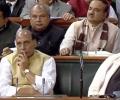
The prime minister was often seen vigorously thumping the desk, prompting his Cabinet colleagues and NDA MPs to follow suit.
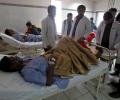
While Prime Minister Narendra Modi's Ayushman Bharat health care scheme is just a slogan for the moment, it is the state's Mukhyamantri Amrutum health assurance scheme which is a comforting reality for many.
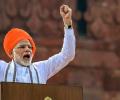
The prime minister highlighted the gains made during his last four years vis-a-vis the previous governments to suggest that he has lived up to the promise of hope he had offered to the electorate in 2014.

Economy to grow by 7.2-7.5 per cent in second half of current fiscal, says FM.
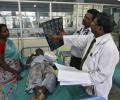
In Chhattisgarh, 40 lakh BPL smart card holders under the state's existing MSBY will be beneficiaries of Ayushman Bharat.
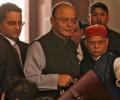
Jaitley said a 10 per cent tax long on capital gains exceeding Rs 1 lakh made from the sale of shares has been introduced but those made till Janaury 31 would be grandfathered. A 10 per cent tax on distributed income by equity oriented mutual funds has also been proposed in the budget.

Finance Minister Arun Jaitley said the fiscal deficit slippage this financial year (2017-18) was largely statistical.
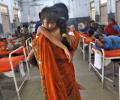
'If you look at household hospitalisation compensation, then you will find only one-third is hospitalisation. Two-thirds is outpatient.' 'Even if you provide Rs 5 lakh coverage, people will still have a tough time.'

The opposition has attacked the Modi government over the National Democratic Alliance's last full-fledged budget before the 2019 Lok Sabha elections.
 © 2026 Rediff.com - Advertise with us - Disclaimer - Privacy Policy - Sitemap - Feedback - About us - Terms of use - Grievances