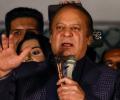
Wasim Qadir, the Pakistan Tehreek-i-Insaf (PTI)-backed candidate who defeated PML-N's stalwart Sheikh Rohail Asghar from Lahore's National Assembly-121 constituency, joined the PML-N after a meeting with Maryam Nawaz, daughter of the party supremo Nawaz Sharif, at her residence.

There was no progress in the formation of a new coalition government in Pakistan on Tuesday as top leaders of the Pakistan Muslim League-Nawaz (PML-N) and the Pakistan Peoples Party (PPP) failed to agree on a power-sharing deal in their latest round of talks, indicating deepening fissures in the country's political landscape.
In a surprise development, Pakistan Muslim League-Nawaz on Tuesday nominated its president Shehbaz Sharif as the prime ministerial candidate of Pakistan instead of the party supremo and three-time former premier Nawaz Sharif.

Among the political parties, the Pakistan Muslim League-Nawaz (PML-N) emerged as the largest party, winning 227 seats, followed by the Pakistan Peoples Party (PPP) with 160 seats.

The three main political parties in Pakistan on Sunday intensified their efforts for the formation of a coalition government after it became clear that the coup-prone country faced a hung Parliament after general elections marred by allegations of rigging.
On Sunday, the Election Commission of Pakistan (ECP) formed the committee to probe the explosive allegations levelled by former Rawalpindi Commissioner Liaquat Ali Chattha that widespread rigging aided by the judiciary and the top election body took place against jailed former prime minister Imran Khan's party in the garrison city of Rawalpindi.

Pakistan's election commission on Sunday declared the final result of Thursday's general elections in which independent candidates backed by jailed former prime minister Imran Khan's party got the biggest piece of the cake by winning 101 seats.

Pakistan's embattled Prime Minister Imran Khan on Wednesday summoned a special session of the federal cabinet amidst reports that two ministers belonging to the ruling coalition partner Muttahida Qaumi Movement-Pakistan have resigned after their party announced that it will support Opposition's no-confidence motion.

As part of the PML-N and PPP alliance, Shehbaz Sharif, the younger brother of former premier Nawaz Sharif, is expected to become Pakistan's next prime minister.
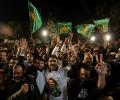
The result is a big blow to the military establishment, revealing the limits of 'political engineering'. It reflected the anger of the electorate, especially its younger voters, who have spoken decisively against the persistent harassment and victimisation of Imran Khan's political party, asserts Rana Banerji, who headed the Pakistan desk at RA&W.
Pakistan's election commission has formed a high-level committee to probe the explosive allegations levelled by a senior bureaucrat that widespread rigging aided by the judiciary and the top election body happened against jailed former prime minister Imran Khan's party in the garrison city of Rawalpindi.

The Election Commission of Pakistan has announced that independent candidates, a majority of them supported by the PTI secured 101 seats, followed by Pakistan Muslim League-Nawaz (PML-N) with 75 seats, Pakistan Peoples Party (PPP) getting 54 seats, and Muttahida Qaumi Movement-Pakistan (MQM-P) bagging 17 seats.

The courts in Pakistan have been flooded with petitions as candidates, mostly backed by jailed former prime minister Imran Khan's Pakistan Tehreek-e-Insaf (PTI), challenged the results of Thursday's general elections, alleging rigging.
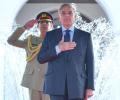
The ceremony was scheduled to be held on Monday, but President Alvi had refused to administer the oath to the lawmakers, compelling the government to postpone it.

Shehbaz Sharif, the younger brother of former premier Nawaz Sharif, is expected to become Pakistan's new prime minister as the coalition of leading political parties led by them is set to comfortably cross the simple majority mark to form the next government after elections produced a split mandate.
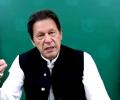
Talking to reporters in Islamabad, he said the Opposition has laid all of their cards, but the no-confidence motion against him would not be successful.

The PTI government lost the majority in the lower house of the parliament following the late-night development ahead of the no-confidence motion against Imran Khan on April 3.

As many as 174 members voted in favour of the motion in the 342-member House while members of the ruling Pakistan Tehreek-e-Insaf were absent during the voting.
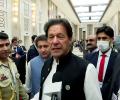
Bugti announced that he would support the Opposition in the wake of the no-confidence motion submitted against Imran Khan. Imran Khan's party Pakistan Tehreek-e-Insaf set to face a no-trust motion in the National Assembly.

With the National Assembly Deputy Speaker Qasim Suri rejecting the no-confidence motion moved by the Opposition, Pakistan Prime Minister Imran Khan on Sunday said that the conspiracy hatched by a foreign country to topple the Pakistan Tehreek-e-Insaf (PTI) government in the country has failed.

"In the coming days if we see a political or constitutional upheaval in Pakistan, or an increase in instability, then we cannot rule out the possibility of another coup in the country," said defence expert Sanjeev Srivastava.

With Pakistan Prime Minister Imran Khan virtually losing the majority in the 342-member National Assembly after the defection of two key allies, backdoor efforts are underway to reach a deal between the premier and the joint opposition to dissolve the lower house, according to a highly placed source.

PTI leader Naeenul Haq told media on Saturday night that consultations are on to complete the number game.

Khan's spokesman Dr Shehbaz Gill said that the prime minister has just a slight fever and cough.
 © 2026 Rediff.com - Advertise with us - Disclaimer - Privacy Policy - Sitemap - Feedback - About us - Terms of use - Grievances