
India's first unmanned moon spacecraft, Chandrayaan-1 has entered the lunar transfer trajectory and is heading to an apogee of 3,80,000 KM as ISRO scientists on Tuesday carried the fifth and final orbit-raising manoeuvre.

Here is the timeline of the moon mission as undertaken by the Indian Space Research Organisation.

He noted that Chandrayaan-3 will be inserted into the lunar transfer trajectory after the orbit raising manoeuvres.

The Chandrayaan-2 spacecraft is expected to reach the moon's orbit on August 20 and land on lunar surface on September 7.

All spacecraft parameters are normal, the Bengaluru headquartered space agency said after the maneuver on the spacecraft.

Vikram (with rover 'Pragyan' housed inside) is expected to touch down on the lunar surface on September 7, between 1.30 am and 2.30 am.
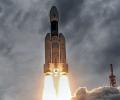
"The duration of manoeuvre was 1,738 seconds. With this, Chandrayaan-2 was successfully inserted into a Lunar orbit," Indian Space Research Organisation said.
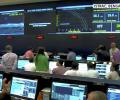
NASA said it is looking forward to explore the solar system with its Indian counterpart.

Hours before Chandrayaan-2's 'Vikram' module's proposed soft landing on the Lunar surface, Indian Space Research Organisation chairman K Sivan said on Friday things are progressing as per plan for the much-awaited event.

Two de-orbit manoeuvres of Vikram Lander, to bring it further down, have been planned to prepare for its landing in the south polar region of the moon.
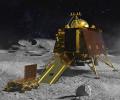
ISRO chairman K Sivan said the proposed soft-landing was going to be a 'terrifying' moment.

Although Russia, United States and China have achieved a soft landing on the lunar surface, India is aiming at becoming the first one to explore the south pole of the Moon.
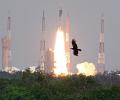
The nine-second de-orbiting or retro-orbiting manoeuvre was executed at 3.42 am using the onboard propulsion system.

The Rs 978 crore mission, which has been rescheduled for Monday after scientists corrected the glitch in the rocket, will be launched at 2.43 p.m from the second launchpad at Satish Dhawan Space Centre, over 100 km from Chennai.
The ISRO is aiming for a soft landing of the lander in the South Pole region of the moon where no country has gone so far.
 © 2026 Rediff.com - Investor Information - Advertise with us - Disclaimer - Privacy Policy - Sitemap - Feedback - About us - Terms of use - Grievances