
'The unexpected turn of events and assertion of sovereignty by the Taliban has baffled the Pakistan security establishment.'
Terror group Al Qaeda is "shaping" its regional affiliate in the Indian subcontinent to spread its operations into Jammu and Kashmir, Bangladesh and Myanmar, according to a UN report.

Two top Taliban and Al Qaeda-linked militants were killed in northern Afghanistan in combat operations conducted by the country's Special Operations Unit and coalition troops, officials said on Monday.
A top Taliban commander was among the five people killed on Friday in a powerful blast in a market in Pakistan's restive South Waziristan tribal region.

I was flogged about 500 in 3 days, they cut my back with blades and removed nails from my hands and feet," said Shahbaz Taseer of the ordeal he endured.
Reports from the NATO forces in Afghanistan of the presence of increasing numbers of Uzbeks, Chechens and Uighurs with the Neo Taliban forces operating in Afghan territory added to the pressure for action. Responding to these pressures, the Pakistani government started sending further reinforcements to the area.
The 13th report of the Analytical Support and Sanctions Monitoring Team cites a UN Member State as saying that Jaish-e-Mohammed (JeM), a Deobandi group ideologically closer to the Taliban "maintains eight training camps in Nangarhar, three of which are directly under Taliban control."

The world's attention is on the new Taliban and the imminent announcement of an inclusive government in Kabul, observes Ambassador M K Bhadrakumar

With Pakistan in mind, Prime Minister Manmohan Singh on Thursday warned that terrorism and radicalism emanating from "our neighbourhood" had directly affected both India and China and could lead to instability across Asia.

Pakistan on Friday released the sketch of an Uzbek national it claimed was the mastermind of last month's deadly attack on Karachi airport, days after the military said he was killed in North Waziristan during an ongoing operation.

Pakistan-based terror groups like the Lashkar-e-Tayiba and the Jaish-e-Mohammed were named on Monday in the Summit declaration of the BRICS countries.

IS-Khorasan was sanctioned for its links with Al Qaeda and involvement in several deadly attacks in Afghanistan and Pakistan that killed over 150 people.

In a blunt message to Pakistan, the United States has said that continued existence of terror safe havens in the country and its inability to take action against them affects their bilateral ties including security assistance.
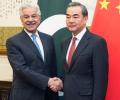
'No one knows Pak and understands Pak better than China,' Chinese Foreign Minister Wang Yi said.
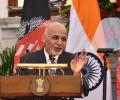
Afghan President Ashraf Ghani on Wednesday pitched for a coherent regional strategy to deal with terrorism
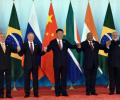
The BRICS also called upon all nations to adopt a comprehensive approach in combating terrorism including countering radicalisation and blocking terror financing sources.

The declaration also names Pak-based terror groups like LeT and JeM.

'Islamic State has declared that the liberation of Islamic Xinjiang from China is an objective. Beijing may well find that Pakistan is unable to assist in any meaningful way,' says China expert Jayadeva Ranade.

It's a packed 5-nation, 9-day, visit for Prime Minister Modi as he heads to Uzbekistan, Kazakhstan, Kyrgyzstan, Turkmenistan and Tajikistan, apart from Ufa in Russia.

'Omar Khorsani has called repeatedly for the most barbaric of attacks. He is very adept on social media. He is, in other words, eerily similar to the ISIS leader Baghdadi.' 'The crux of the army's 'strategic asset' policy -- its policy of regarding militants as those that can help Pakistan pursue its regional interests -- is that Pakistan needs help in weakening India or in keeping its presence minimal in the region.' Michael Kugelman reveals what the world can expect next from the Tehreek-e-Taliban Pakistan, the terrorists responsible for the Peshawar school massacre.

'Whether it's investments in Kashmir, building naval facilities, or selling top-of-the-range military equipment, Pakistan could well benefit more under Xi's watch.' 'Do Chinese concerns about the 'Islamisation' of Pakistan give it pause about how quickly to move forward with security and economic projects? At the moment the indication is quite the opposite: China is doubling down on its support to Pakistan, partly because of its fears about where the country is headed.'
 © 2026 Rediff.com - Advertise with us - Disclaimer - Privacy Policy - Sitemap - Feedback - About us - Terms of use - Grievances