
India's indigenous fighter jet programme reached a key milestone on Friday, October 17, 2025, as the Tejas Mk1A made its maiden flight at Hindustan Aeronautics Limited's Nashik facility.
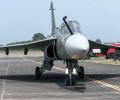
HAL executives said deliveries of the Tejas Mk1A to the IAF would begin within this year, but only after the successful completion of the weapons-firing trials currently underway.
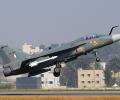
Glimpses from Day 1 at Aero India 2025 at the Yelahanka air base in Bengaluru, India, February 10, 2025.

HAL's sustained, long-term income will come from the design, development, manufacture, overhaul, and upgrade of a family of helicopters designed for deployment on India's 21,000-foot-high Himalayan frontier with Pakistan and China.
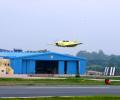
The Indian Air Force will induct the indigenous HTT 40 basic trainers in "large numbers", which will boost the domestic capability although it was earlier keen for a Swiss aircraft.

During these seven decades, the IAF has lost 2,374 aircraft to crashes. They include 1,126 fighters and 1,248 non-combat aircraft. In addition, 229 trainers and 196 helicopters have crashed. These crashes have resulted in the deaths of 1,305 skilled pilots, note Ajai Shukla and Devesh Kapur.

HAL made its point against a sceptical Indian Air Force, which opposed the HTT-40 project, blocked funding, and imported an expensive Swiss trainer rather than backing the HTT-40.
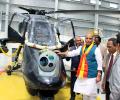
The army, air force and navy will all benefit from the defence ministry's approval of 'Make in India' equipment.
The test flight is a victory for public sector undertaking Hindustan Aeronautics Limited, which has strongly backed the Hindustan Turbo Trainer-40 project, defying a skeptical Indian Air Force
Top HAL sources say the AMCA, which is being developed as the IAF's next-generation stealth fighter, is slated to be assembled at HAL Nashik.

An IAF "request for information" floated on the MoD website invites Indian companies to submit preliminary bids to supply the IAF with 106 PC-7 Mk II trainers. Ajai Shukla reports
50 terrorists had been killed this year while 12 security forces personnel lost their lives.
India's indigenous basic trainer aircraft, Hindustan Turbo Trainer-40 (HTT-40), undertook its inaugural flight at the at the Hindustan Aeronautics Limited Airport in Bengaluru on Friday.
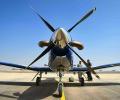
Instead of the Hindustan Turbo Trainer-40, which Hindustan Aeronautics Ltd could build, export, overhaul, upgrade and even modify into a light-attack aircraft, powerful lobbies have promoted a Swiss trainer -- the Pilatus PC-7 Mark II.
HAL's HTT-40 aircraft have outperformed both Swiss Pilatus planes and the IAF's performance criteria. Why then does the IAF prefer the Pilatus to the HTT-40?
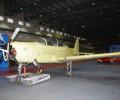
In a boost to 'Make in India, the HTT-40 rolled out of the hangar with all its lights flashing and its cockpit powered on.

Meanwhile, Congress president Rahul Gandhi took a swipe at the Modi government and Anil Ambani over the Rafale issue, saying that in order to bag India's biggest defence contracts one has to be a "defaulter of Rs 45,000 crore" and have "no relevant experience".
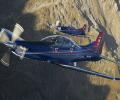
Indian Air Force chief, Air Chief Marshal N A K Browne, has sugarcoated his bid to import 106 basic trainer aircraft from Pilatus Aircraft Co, by proposing that Hindustan Aeronautics Ltd build the trainers in Bengaluru to blueprints supplied by the Swiss company.

The Indian Air Force argued that Hindustan Aeronautics Limited's HTT-40 trainer jet would be costlier than the Swiss Pilatus trainer over its 30-year service life. When HAL challenged this contention, the IAF was not able to back it with figures.
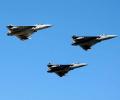
The HAL wants the IAF to buy 80 Tejas Mark I-A to keep the production line occupied from 2020 to 2023-24
 © 2026 Rediff.com - Investor Information - Advertise with us - Disclaimer - Privacy Policy - Sitemap - Feedback - About us - Terms of use - Grievances