
The Madhya Pradesh High Court will decide whether Jain individuals can seek relief under the Hindu Marriage Act, including divorce by mutual consent. This decision stems from a family court's refusal to accept a divorce petition from a Jain software engineer, citing the community's minority status. The high court appointed an amicus curiae to assist in the case, and the next hearing is scheduled for March 18.

The Allahabad High Court has ruled that a wife cannot be denied maintenance under Section 125 of CrPC merely because she is highly qualified or possesses vocational skills.

The Allahabad high court has observed that marriage between two Hindus is sacrosanct and it cannot be dissolved within one year of marriage unless there is exceptional hardship or exceptional depravity as provided under the Hindu Marriage Act.

'Caring for one's parents is the husband's responsibility, especially if he is the earning member of the family.' 'The wife may be financially dependent on him but that does not create a legal obligation for her to serve or care for her in-laws.'
The Allahabad High Court has refused to grant protection to a live-in couple, citing the woman's existing marriage and the principle that one person's freedom cannot infringe upon another's legal rights.

The Supreme Court on Friday asked the Law Commission to consider a plea as a representation of a Buddhist group that certain sets of personal Hindu laws, which are applicable to Buddhists also, are against their fundamental rights, including freedom to practice religion.

The sacrament based Hindu marriage may be dissolved (in law), in limited circumstances and too only on the strength of evidence led by the parties, it said.

In its order on March 22, the court said the Hindu Marriage Act merely provides for saptpadi (seven steps or saat pheras) as an essential ceremony of a marriage.
'A marriage is not an event for 'song and dance' and 'wining and dining' or an occasion to demand and exchange dowry and gifts by undue pressure leading to possible initiation of criminal proceedings thereafter'

The Supreme Court of India dissolved a marriage, instructing the couple to prioritize their child's well-being and set aside personal differences.

"If the marriage is not a valid marriage, according to the law applicable to the parties, it is not a marriage in the eyes of law. The 'Saptapadi' ceremony under the Hindu Law is one of the essential ingredients to constitute a valid marriage but the said evidence is lacking in the present case," the court said in a recent order.

Indian cricketer Yuzvendra Chahal and his estranged wife Dhanashree Verma have been granted a divorce by mutual consent by a family court in Mumbai.

Pakistan's Hindus were set to get an exclusive personal law to regulate marriages after the National Assembly unanimously adopted the Hindu Marriage Bill, 2017, on Thursday.

The Bombay High Court on Wednesday waived the mandatory six-month cooling-off period for cricketer Yuzvendra Chahal and his estranged wife Dhanashree Verma's divorce plea

The Bombay High Court has ruled that a spouse threatening or attempting to commit suicide amounts to 'cruelty' and is a valid ground for divorce. The court upheld a family court's decision to dissolve a marriage where the husband alleged his wife threatened to send him and his family to jail by committing suicide. The court found that the husband's claim of cruelty was supported by evidence, including the wife's attempt to end her life.

The plea argued that any changes such as inclusion of same sex marriage in the Customary Law are much easier, convenient and practical in marriages which are a type of contract between the partners as they are very remotely based on religion and more generic in nature.

The Supreme Court of India has dismissed a public interest litigation (PIL) seeking to make dowry harassment and maintenance provisions "gender neutral." The court stated that it cannot legislate law and it is the responsibility of Parliament to look into such matters. The PIL, filed by an NGO, argued that these provisions are often misused to harass husbands and their families. The court, however, emphasized that every case must be judged on its own merits, and that the provisions are intended to protect women and children. The court also noted that the allegation of misuse was vague and that such claims should be examined on a case-by-case basis.
The Hindu Marriage Bill 2017, which is the first elaborate Hindu community's personal law, was adopted by the Senate on Friday.
After decades of delay and inaction, the Hindu minority community in Pakistan will soon have a marriage law as a parliamentary panel has unanimously approved the Hindu Marriage Bill.

The Bombay high court has directed a working woman to pay monthly maintenance of Rs 10,000 to her former husband who is unable to earn due to his ailments.

Children born under the Special Marriage Act have equal rights over both parents' properties, regardless of their parents' religion or background.
The petitioner husband, who was stated to have abandoned his wife and children and was living with another woman, was ordered by the trial court to pay Rs 30,000 per month as maintenance to his wife, along with Rs 5 lakh towards the "injuries" sustained by her, including mental torture, depression and emotional distress.
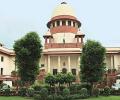
The judgement has dealt with the question whether the share of such children is limited only to the self-acquired property of their parents under Section 16(3) of the Hindu Marriage Act.
The high court said instead of giving a quietus to their disputes, the woman had chosen to continue with divorce proceedings by making unsubstantiated allegations.
In a historic move, Pakistan's parliament has passed the much-delayed bill to enable the country's minority Hindu community to register their marriages.
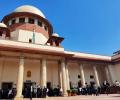
A bench of Justices Sanjiv Khanna and MM Sundresh said the word 'cruelty' under Section 13(1)(ia) of the Hindu Marriage Act of 1955 has no fixed meaning, and therefore, gives a very wide discretion to the Court to apply it "liberally and contextually".
A five-judge Constitution bench said the SC is empowered under Article 142 of the Constitution to do complete justice.
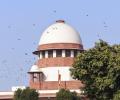
The Supreme Court has told a couple, who are software engineers seeking divorce, why don't they give a second chance to the marriage as both of them were not able to devote time to their union.

The Delhi high court on Monday sent to the Supreme Court a batch of petitions seeking to recognise same-sex marriages under various laws.

In what could be a landmark moment for the minority Hindu community of Pakistan, Hindus will get Computerised National Identity Cards if the amended Bill is passed, something they have not been entitled to so far, reports Amir Mir
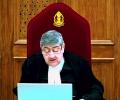
People must have tolerance for each other's opinion at a time when the tolerance level has gone down internationally, Supreme Court judge Justice Sanjay Kishan Kaul said on Friday.

The Supreme Court has agreed to examine a plea on whether seeking details of hotel stays and call records to prove allegations of adultery are violative of the fundamental right to privacy under Article 21 of the Constitution.

The National Commission for Protection of Child Rights (NCPCR) has moved the Supreme Court against the legalisation of same-sex marriages.

The evidence on record, from close scrutiny, also leads to the conclusion that the wife used to insult the husband on the premise that he is dark and for the same reason has moved away from the company of the husband without any cause, the court noted.
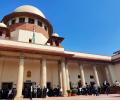
A five-judge constitution bench of Justices SK Kaul, Sanjiv Khanna, A S Oka, Vikram Nath and J K Maheshwari had reserved its judgement on September 29, 2022.
The top court said despite the increasing trend of filing divorce proceedings in courts, the institution of marriage is still considered to be a pious, spiritual and invaluable emotional life-net between couples in the Indian society.

The Supreme Court said on Thursday it will examine the larger constitutional issue of challenge to the validity of extrajudicial divorce like 'talaq-e-hasan' among Muslims.
Article 142 of the Constitution deals with the enforcement of decrees and orders of the apex court.

Quoting verses from Surah Al Bakra in Qur'an, Justice Krishna S Dixit said a pious Muslim owes a moral and religious duty to provide subsistence to his destitute ex-wife.

The Centre on Thursday told the Supreme Court, which is hearing arguments on a clutch of pleas seeking legal sanction for same sex marriages, that arguments about freedom of sexual orientation and autonomy may be raised in future to challenge incest prohibition.
 © 2026 Rediff.com - Advertise with us - Disclaimer - Privacy Policy - Sitemap - Feedback - About us - Terms of use - Grievances