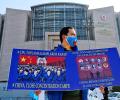
A top leader of the ruling Communist Party has asked China's over 25 million Muslims to "uphold the banner of patriotism" and reorient Islam to adapt to Chinese conditions, amid Beijing's diplomatic offensive to counter a damning UN report accusing it of serious human rights violations against Uygur Muslims.
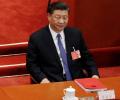
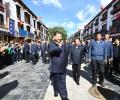
During his four-day tour of the region which started on July 12, Xi met with officials.

Several videos have emerged on social media which showcased people chanting slogans against restrictions imposed by the Chinese government to curb the spread of Covid.

The exiles allege that China's security forces indiscriminately fired on the protesters in many places in the city. In the clashes between the students and the security forces, which continued throughout the night of July 5, many were killed. Xinhua has admitted at least 140 fatalities. The exiles claim the figure is 600.

China's ruling Communist Party has appointed Wang Junzheng, sanctioned by the US, Britain, EU and Canada for his alleged role in the human rights violations against Uygur Muslims in Xinjiang, as the head of its party unit in the sensitive Himalayan region of Tibet.
'Is China's intention not clear?' 'Do we still think that if we are nice to China, it will be good to us?'
China's Inner Mongolia, where Mongolians are in a minority of only 20 per cent out of the total population of 23 million, has been going through a Jasmine- type revolution since May 10. There have been widespread protests in different towns following the death of a herdsman by name Mergen who was allegedly killed by a Han Chinese truck driver during a protest against mining operations in their area.
China has so far convicted 198 people linked to the bloody ethnic riots last July in its troubled Xinjiang region, a top official said on Sunday, warning that final figure will be more.

Despite a lot of lip service to national unity, functional relations between the Han Chinese immigrants and the Uyghur regional majority have not developed on equitable basis, says R Hariharan
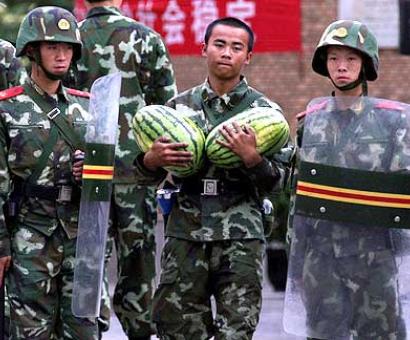
Even as China's riot-hit Urumqi is showing signs of normalcy, the death toll in the weeklong clashes between the Han Chinese and Uighur communities continues to rise.
Will heads roll after Hu's return? Will the rolling heads be confined to Urumqi or will they cover Beijing too? Is the situation in Xinjiang likely to weaken Hu's leadership of the CCP? These are questions for which one has to look for answers in the days to come.
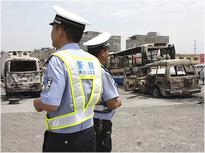
Fresh unrest has broken out in China's restive northwestern region of Xinjiang, where over 156 people have died in the worst communal flare up in decades leading to the arrest of over 1,400 people, including 55 women, in a massive crackdown.
31 Chinese climbers are on Mount Everest fixing routes and repairing camps for the final assault on the summit with the Beijing Olympic torch.
"We have received information that after the Olympics 1 million Chinese are going to settle in the autonomous region of Tibet," the Dalai Lama said in an interview published in the Guardian on Saturday. He said: "There is every danger of Tibet becoming a truly Han Chinese land and Tibetans becoming an insignificant minority. Then the very basis of the idea of autonomy becomes meaningless."
The first priority for the new Tibetan administration in Dharamsala should be to look at Tibetan recruitment in the PLA, suggests Claude Arpi.

Dozens of civilians were killed or wounded in a major terror attack by knife-wielding extremists in China's restive Xinjiang province, the police said on Tuesday. A gang armed with knives attacked a police station and government offices in Elixku Township in Shache County, Kashgar Prefecture. Some of the attackers then moved on to the nearby Huangdi Township, attacking civilians and smashing vehicles as they passed.
'Today, our vast green pastures where local herders used to take their cattle to graze have been taken over by the Chinese.' 'The people in the Galwan Valley have lost their lands where their cattle used to graze.'

'Neither will China -- at least for now -- because its troops are deployed in equal strength.' 'We are negotiating at equal terms right now and it's a game of patience.'

With Pakistan in mind, Prime Minister Manmohan Singh on Thursday warned that terrorism and radicalism emanating from "our neighbourhood" had directly affected both India and China and could lead to instability across Asia.
'The logical step is to challenge the very legitimacy of the Chinese claim over Tibet,' recommends Inspector General Gurdip Singh Uban (retd).
'The goal is achievable. What is stopping us from getting there?' asks Aakar Patel.

An explosion on Wednesday rocked a railway station in Urumqi, capital of China's volatile Muslim-majority Xinjiang province. Details about the blast and casualties are unclear, state-run Xinhua news agency reported, citing officials.

'Islamic State has declared that the liberation of Islamic Xinjiang from China is an objective. Beijing may well find that Pakistan is unable to assist in any meaningful way,' says China expert Jayadeva Ranade.

'India in 2020 is a lot better prepared than in 1962.' 'It is no longer a pushover; and anything other than a crushing Chinese military victory will be a major loss of face for China,' observes Rajeev Srinivasan in the first of a three part column.
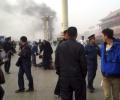
Fifteen people, including 11 'mobsters', were killed and 14 others injured in a terrorist attack in China's restive Xinjiang province on Saturday. The attack occurred at ShacheCounty in the northwestern province, state-run Xinhua news agency reported.

Madhu Kishwar is a patriot whose freedom of expression needs to be supported by all, especially the liberals, says Sankrant Sanu.

Four knife-wielding persons on Tuesday went on the rampage at a busy railway station in China's Guangzhou city injuring six people, including two women and a foreigner, in the third such attack in over two months with authorities blaming the first two on militants from Xinjiang.

'Lhasa is more than the Unesco World Heritage Sites it boasts of. It is more than a gateway to the mighty Himalayas.' 'It is about the warmth of its people: Unsaid, unspoken, but felt everywhere,' discovers Shruti Bajpai.

The battle against militants fighting for separation of China's volatile Xinjiang province, bordering PoK and Afghanistan, is getting "tougher, fiercer and crueler than ever" due to the revival of pan-Islamic extremist groups, top Chinese leaders from the province said.

In a major breakthrough in China's worst terrorist attack at the Kunming railway station, police on Monday captured three militants from the restive Xinjiang province who fled the scene of slashing rampage that killed 33 people and injured 143 others.

Communist China has recently developed a great expertise in 'soul reincarnation', feels Claude Arpi

The world must hang its head in shame for being a mute spectator to the 'cultural holocaust' in Tibet, says Major General Mrinal Suman (retd).

The chaos on its stock markets, a fierce battle between the old and new guard in the Communist Party and the restive border provinces of Tibet and Xinjiang forebode tough times ahead for China, says Claude Arpi.
 © 2026 Rediff.com - Advertise with us - Disclaimer - Privacy Policy - Sitemap - Feedback - About us - Terms of use - Grievances