

A profile of veteran Nepali politician K P Sharma Oli, detailing his rise to power, his various stints as prime minister, and his impact on Nepal's political landscape.
A day before the declaration of abolition of monarchy, the Maoists in Nepal agreed to the provision of a ceremonial president with executive powers to prime minister. Initially, the Maoists wanted a presidential system and a ceremonial prime minister. However, other major political parties--Nepali Congress and UML-- wanted the prime minister with executive powers and a ceremonial president.
All the charged ministers and army chief had admitted to having misused state funds during their interrogation, the commission said.

Nepal's five-time Prime Minister Girija Prasad Koirala, who had been unwell for several months, died here today after multiple organ failure.
The Loktantra Day celebrations will continue till April 25.
Nepalese Prime Minister Girija Prasad Koirala on Thursday resigned from his post, ending a two-month long deadlock to pave the way for the country's first ever Maoist-led government. Koirala, 83, announced his resignation while addressing the Constituent Assembly, which was elected in April to rewrite the constitution and govern the Himalayan nation, Nepali Congress Assembly member Tirtha Ram Dangol said.
The meeting also covered bilateral relations, ongoing peace process in Nepal and the agitation in the Terai region bordering India, they said.
Koirala told the former rebel that they should wait until the constituent assembly elections expected in June.
He appreciated Prime Minister Koirala for successfully moving ahead with the peace process.
Nepalese opposition leader Girija Prasad Koirala has asked Prime Minister Prachanda to run the government with consensus of all the stakeholders, and said his talks with the Indian leaders revolved around this and dismissed reports that he sought New Delhi's help to oust the Maoists-led ministry.
The political situation in Nepal and the ongoing peace process figured in talks India's Ambassador to the country Shiv Shanker Mukherjee on Wednesday held with the acting Prime Minister Amik Serchan.
Nepal's Maoist leaders have suggested a referendum to decide the fate of the monarchy if the country is not declared a republic through parliament. Maoist chairman Prachanda and his deputy Dr Babu Ram Bhattarai, recommended a referendum to Prime Minister Girija Prasad Koirala during their meeting on Sunday.
Nepal's major parties on Wednesday failed to break an impasse over the formation of a new government as efforts to strike a deal on sharing of power proved futile. During crucial talks in Prime Minister Girija Prasad Koirala's residence here, the Maoists rejected a proposal from Nepali Congress and the CPN-UML to amend the interim constitution to remove a provision requiring two-thirds majority for forming or unseating the government.
Ending a political deadlock, Nepalese Prime Minister Girija Prasad Koirala on Saturday invited the Maoists to form a government, more than a month after they emerged as the biggest party in the Constituent Assembly polls.
The government's decision to deploy new security posts along the border comes at a time when there are reports about the possible infiltration of Hindu groups from India into the Madhesi movement in the Terai plains, turning it violent.
The delegation met Nepalese Congress President Girija Prasad Koirala.
The elections, which are set to usher in democracy ending the 40-year monarchy, saw the first seat going to Prime Minister Girija Prasad Koirala's Nepali Congress party, whose candidate Prkash Man Singh won one of the constituencies in Kathmandu. Maoist chairman Prachanda, Maoist war time strategist Ram Bahadur Thpa (Badal), its spokesman Krishna Bahadur Mahara and two female Maoist leaders Pampha Bhushal and Hisila Yami are leading in their respective constituencies.
With Koirala no more, Asia has lost yet another grand old man of politics - the likes of him have always been rare.
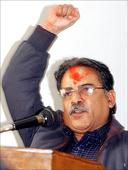
An image of Maoist leader Prachanda speaking at a public function.
The peace talks between the government and the Maoists, which were postponed about a month ago, will resume in Kathmandu on Monday.
The decision was taken at a cabinet meeting chaired by Prime Minister Girija Prasad Koirala on Tuesday.
The three-month ceasefire, announced by the Maoists on April 27, will be extended to facilitate the peace talks with the seven-party alliance government, said rebel spokesman Krishna Bahadur Mahara.
In an effort to forge lasting peace in Nepal, the Girija Prasad Koirala government has initiated the process of releasing jailed Maoists after the rebels agreed to hold a dialogue with it to end the decade-old insurgency in the Himalayan kingdom.
The occasion passed unnoticed by many as there were no grand celebrations, with the prime minister receiving gifts from party workers and well-wishers at his Baluwatar home and not venturing out, sources close to his family said.
However, the exact date for the polls will be fixed by the cabinet
The formation of the new government, which was expected on Friday, was delayed due to last-minute wrangling over the distribution of portfolios.
Koirala said the government will immediately amend the Constitution to fulfil the genuine demands of the Terai people.
The government issued a circular that all government offices, schools and colleges will be closed to celebrate the historic peace accord that aims to put an end to the insurgency that claimed 15,000 lives.
The yoga training was scheduled to start at the Tundikhel ground on Saturday afternoon and Prime Minister Girija Prasad Koirala was invited as the chief guest.
Communist Party of Nepal (United Marxist Leninist) leader K P Sharma Oli has been made deputy premier and foreign minister.
Hundreds and thousands participated in nationwide victory rallies on Tuesday. Leaders of political parties addressed public meetings assuring the people to restore peace and institutionalise democracy.
Koirala is currently busy in hectic consultations with his party colleagues as well as top leaders of the major political parties to form a new Interim government inclusive of the Maoists.
 © 2026 Rediff.com - Advertise with us - Disclaimer - Privacy Policy - Sitemap - Feedback - About us - Terms of use - Grievances