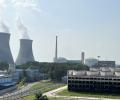
Ushering in reforms, Union Finance Minister Nirmala Sitharaman on Saturday proposed to open up the nuclear power sector for private players and announced a Rs 20,000 crore Nuclear Energy Mission for research in the field, with an aim to set up five small and modular reactors by 2033.

Barely days after imposing a 40 per cent export tax on onions to cool down soaring prices, which, in turn, triggered widespread protests across the main growing belts, the Centre on Tuesday sought to mitigate both political and economic tensions gripping parts of Maharashtra. It decided to procure an additional 200,000 tonnes of onions at Rs 2,410 per quintal for its buffer stock from farmers, a rate that is strikingly close to the price at which they were being exported before the 40 per cent duty was levied on August 19. The export price before the imposition of the duty stood at around $320 per tonne free on board (approximately Rs 2,650 per quintal).

Atomic Energy Commission (AEC) Chairman Anil Kakodkar has said work on India's nuclear programmes will continue despite media reports of the country's nuclear power plants being placed on alert and being made more secure to prevent a terror strike.

Nuclear tests of 1998 have given us capability to build deterrence both in fission and fusion categories, Anil Kakodkar, Chairman, Atomic Energy Commission, said on Thursday.

"We have the technical expertise and capability to build nuclear-powered aircraft carriers and warships of global standards," Kakodkar said, on the sidelines of a function in Mumbai last night.
DAE officials, who had marathon discussions for the last two days in Mumbai on the issue of safeguards to be discussed with the IAEA, received confirmation of an appointment with ElBaradei on Sunday night to initiate negotiations, the DAE sources said.
If IIT-Bombay Chairman Anil Kakodkar has his way, studying at any of the 15 IITs across the country will now cost Rs 250,000 every year against the current Rs 50,000. Is this hike justified?
If the IIT Council has its way, fees for the most prestigious engineering institute will shoot up fivefold.
Official sources said Kakodkar will meet Chief Minister Donkupar Roy and other government officials, besides conveying the Centre's views to the anti-mining groups, including political parties in the ruling coalition like the Hill State People's Democratic Party and Khun Hynnieutrip National Awakening Movement.
Delivering a public lecture on 'Evolving Indian nuclear programme: Rationale and perspectives' organised by Indian Academy of Sciences in Bangalore on Friday, he said the currently-known uranium resources in the country were enough for setting up nearly 10,000 MWe installed capacity pressurised heavy water reactors and the country will need to import nuclear reactors and the fuel to achieve energy security.
Referring to global energy needs, Kakodkar said nuclear power had the pontential to meet these requirements in a sustainable manner and at the same time keep carbon dioxide emissions at the lowest possible levels.
India will now develop its own stockpile of nuclear fuel to fulfil its energy needs, taking advantage of the guarantees given in the Indo-US civil nuclear agreement, Atomic Energy Commission Chairman Anil Kakodkar said on Thursday.
The Centre is reviewing the security measures at nuclear power plants across the country, in the wake of the recent terror strikes in Mumbai, Atomic Energy Commission Chairman Anil Kakodkar said on Thursday."Several security measures have already been put in place. We are reviewing in the context of what happened in Mumbai and certainly whatever additional (security), which are necessary, we will put in place," he said.
Last week, the third round of talks in Vienna failed to ready the agreed text and the next round is scheduled to begin on Wednesday. Originally, the third round was considered to be the final round but there was no agreement on the issue of India's right to hold its strategic reserve to cater lifetime supply to its civilian nuclear plants.
There was no question of India accepting outdated technology under the proposed Indo-US nuclear energy cooperation agreement, Atomic Energy Commission Chairman Anil Kakodkar on Wednesday said.
The safeguards issue is unlikely to come up at Thursday's meeting of IAEA's Board of Governors and will come up for approval at a special Board meeting later. IAEA Director General Mohamed El-Baradei and Atomic Energy Commission chairman Anil Kakodkar initiated the talks.
Amid the diplomatic and political storm generated by the disclosures on the India-United States nuclear deal, US Ambassador to India David Mulford met Prime Minister Manmohan Singh in New Delhi on Thursday and sought to clarify Washington's stand.Although officials were tight-lipped about what was discussed at the meeting, sources said Mulford told the Prime Minister that no new conditions had been introduced.A senior US embassy official sought to play down the meeting.
Atomic Energy Commission Chairman Anil Kakodkar on Saturday met representatives from various NGOs in Meghalaya, in an attempt to acquire their consent for uranium mining in the state.In view of the opposition to uranium mining by various NGOs and at least two political parties the Hill State People's Democratic Party and Khun Hynniewtrep National Awakening Movement the state government had earlier constituted two expert committees to study the possible impact of mining.
The agreements included a declaration on nuclear energy and a pact on defence cooperation.
Kakodkar took over as Chairman, AEC from Dr R Chidambaram in November 2000 and was the first chairman to get three extensions -- in 2003, 2005 and 2007 -- in the history of India's nuclear programme.
Kakodkar had come to inaugurate the fourth Asian Particle Accelerator Conference at the Raja Ramanna Centre for Advanced Technology near Indore.
Without giving the location of the reactor, he said it would cost Rs 5 to 6 crore per MW.

UN atomic energy chief Mohammed El-Baradei began a three-day visit to India as the ruling United Progressive Alliance-Left alliance appeared headed for a break-up over the India-United States civil nuclear energy pact.
He was responding to a query on NSG guidelines that restrict the export of reactors by members of the grouping, including the US, France, Russia, Australia and Japan.
India currently has a total nuclear power generation capacity of about 3,800 MW and plans to scale it up to 20,000 MW by 2020.
The top scientist said India's ambition should be to do something which no other nation has attempted so far.
Nuke scientists support AEC chief's contention
New Delhi has made it clear that the issue of reprocessing of spent fuel is 'non-negotiable' and it is committed to retaining the right to do so.
Atomic Energy Commission chairman Anil Kakodkar on Tuesday expressed optimism about clinching an agreement with the International Atomic Energy Agency and implementation of the Indo-US nuclear deal.
The project will research a clean and limitless alternative to dwindling fossil fuel reserves by testing nuclear fusion.
Dr Kakodkar made light of the suggestion that the NSG would meet only in April 2007, which could possibly impact the deal.
International experts reaching Vienna for the 51st general conference of the IAEA are understood to be keen to know about the opportunities likely to emerge if the Indo-US civil nuclear deal goes through.

Despite optimism that the deal will be sealed, differences marred talks between the two sides.
Atomic Energy Commission Chairman Anil Kakodkar on Friday expressed concern at the insertion of new clauses of an "intrusive" nature in the bill passed by the US Senate to implement the civil nuclear deal with India.
 © 2026 Rediff.com - Advertise with us - Disclaimer - Privacy Policy - Sitemap - Feedback - About us - Terms of use - Grievances