
Glimpses of the destruction in Ukraine caused by Putin's senseless war.

In the test, a space rocket boosted a hypersonic glide vehicle, one capable of carrying a nuclear device, which circled the globe before impacting.

India's missile defence system is set to get a big boost as it is developing capability to intercept enemy missiles fired from a distance of up to 5,000 km, in effect tackling any possible threat from countries such as China. The capability is being developed by DRDO as part of the Ballistic Missile Defence shield, whose first phase is ready for deployment possibly in Delhi
The strategic planning has already begun to install the BMD system in the two cities and the final proposal will be put before the government after detailed analysis of the entire project, sources told PTI in New Delhi.
After carrying out major upgrades, India will test fire an advanced version of its indigenous Ballistic Missile Defence system in February allowing it to destroy enemy rockets at a much higher altitude.
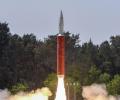
He said the country now possesses the capability to strike satellites in outer space with centimetre-level accuracy and precision.
Barely a month after carrying out successful tests of Interceptor missiles, India is in talks with a leading American aerospace firm to apparently seek collaboration to develop a robust ballistic missile defence (BMD) system.

The Ababeel missile brings many Indian cities within its range.

'Everybody spies on their friends as well as their enemies. That's the way the world works these days'

The US space agency also warned that the risk of debris colliding with the International Space Station has risen by 44 per cent since Mission Shakti.

'India must close the missile technology gap with both China and Pakistan as early as possible, or else the credibility of India's nuclear deterrence will remain suspect,' says Brigadier Gurmeet Kanwal (retd).

The Mars mission is overwhelmingly irrelevant to space science and won't advance the frontiers of knowledge. It will divert attention from the real technological challenges facing the Indian space programme, and will further distort our science and technology priorities, says Praful Bidwai.
India is only the fourth country to acquire such a specialised and modern capability after the United States, Russia and China.

The $10.5 billion arms and equipment deal helped to arrest the recent drift in the 'special and privileged' strategic partnership, observes Brigadier Gurmeet Kanwal (retd).

'In India, China's capacities to conduct new types of warfare is critically underestimated,' says Claude Arpi.
 © 2026 Rediff.com - Advertise with us - Disclaimer - Privacy Policy - Sitemap - Feedback - About us - Terms of use - Grievances