
Asim Munir, who was promoted to the Field Marshal rank this year, will also simultaneously hold the office of the Chief of Army Staff, along with his duties as CDF.
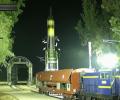
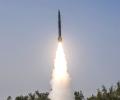
India successfully test fired the Agni-Prime missile from a rail-based mobile launcher. The next-generation missile has a range of up to 2,000 kilometers and advanced features.
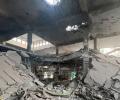
Pakistan is considering creating a new position of 'Commander of Defence Forces' (CDF) to improve coordination and unified command among its military services, according to media reports. The move is part of broader defence reforms and is reportedly influenced by recent conflicts and the evolving nature of modern warfare.

He will report to the chairman of the Chiefs of Staff Command, navy chief Admiral Madhvendra Singh.

India successfully test-fired nuclear-capable short range ballistic missiles Prithvi-II and Agni-I from an integrated test range off the Odisha coast, demonstrating its strategic deterrence capability. The test-firing of the missiles, conducted by the elite Strategic Forces Command, validated all operational and technical parameters.

India successfully test-fired the 'Agni 5' intermediate range ballistic missile, capable of reaching targets up to 5,000 km, validating its operational and technical parameters.
Two operational missile groups of the Indian Army -- one with the 150-250 km short-range Prithvi missiles and the other in charge of the longer-version 2,500 km Agni missiles, would form the nucleus of the new Strategic Forces Command.
A decision to this effect was taken at a two-hour long meeting of Cabinet Committee on Security chaired by Prime Minister Vajpayee.
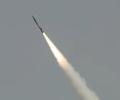
The army said the missile launch was part of "Exercise INDUS" without giving details about the exercise.
The Strategic Forces Command responsible for the nuclear arsenal of the country will be headed by Air Marshal KJ Mathews, who will take over from Lieutenant General Balraj Singh.
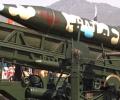
'The Indian gung-ho leadership may like to think about it, there should never ever be a doubt in anyone's mind, friend or foe, that Pakistan's operationally ready nuclear capability enables every Pakistani leader the liberty, the dignity and the courage to look straight into the Indian eye and never blink.'

The defence ministry said the test-flight was carried out on Wednesday evening and it met all the trial objectives, validating the reliable performance, as confirmed from the data captured by a number of range sensors deployed at different locations.

Almost five years later, the three services have still not fully understood that joint/theatre commands are not a discussion point; they are the prime minister's diktat on a military reform measure that is in line with what armed forces around the world have implemented, points out Ajai Shukla.

'Agni Prime', the new-generation ballistic missile, was successfully flight-tested from an island off the Odisha coast on Thursday, officials said.

The sources said the President, who is also the supreme commander of the three services, signed the order terminating the services of the Major around a week ago while exercising powers under the Army Act, 1950.
The proposal is also important as it comes at a time when the Indian forces are working on the creation of a rocket force which has been in discussion at the highest levels in the Defence Ministry.

Aware of simmering dissensions within the top echelons of the army, Munir has moved slowly in reshuffling senior generals, observes Rana Banerji, who headed the Pakistan desk at RA&W, India's external intelligence agency.

The extended range of the missile which is part of the Strategic Forces Command will give a variety of options to the planners during times of conflict.

The test-firing of the missile from the Abdul Kalam Island off Odisha coast came amid India's lingering border row with China.
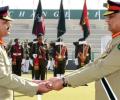
It could be part of a deliberate strategy to heal divisions within and restore the Pakistan army's image, explains Rana Banerji, who headed the Pakistan desk at RA&W.

In a brief statement, the defence ministry said the "training launch" of the missile was carried out at around 7:30 pm.
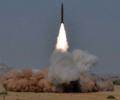
Pakistan on Thursday successfully test-fired a ballistic missile capable of carrying nuclear and conventional warheads to targets as far as 1,500 kilometres, bringing many Indian cities under its range.

In a major boost to its military might, India on Wednesday successfully test-fired surface-to-surface strategic missile Agni-5 that can strike targets at ranges up to 5,000 km with a very high degree of accuracy, officials said.

16 Indian Army divisions face China, 20 face Pakistan and two divisions are reserves. This powerful signal can hardly be missed in China or Pakistan, notes Ajai Shukla.

The Command has successfully evolved in the last 20 years into an operationally efficient template for theaterisation of the armed forces, Chief of Defence Staff Bipin Rawat said.

Agni-I missile is equipped with sophisticated navigation system which ensures it reaches the target with a high degree of accuracy and precision.
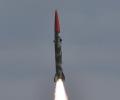
Pakistan on Tuesday successfully test-fired a short-range surface-to-surface ballistic missile Hatf III (Ghaznavi), capable of carrying nuclear and conventional warheads to a range of 290 kilometres, that could cover parts of India.

General Bajwa and the outgoing DG, ISI Lieutenant General Naveed Mukhtar, had a long meeting with Prime Minister Imran Khan on Friday, says Rana Banerji, who headed the Pakistan Desk at the Research and Analysis Wing, India's external intelligence agency.

General Bajwa remains in command as army chief and Prime Minister Imran Khan did not play any role in the reshuffle, says Rana Banerji, who headed the Pakistan Desk at the Research and Analysis Wing, India's external intelligence agency.

as journalists active in Pakistani media have been quick to point out, with Ghafoor at the helm in Balochistan, no one will take seriously any claims by the civilian leadership to use the velvet glove to work for peace there, points out Rana Banerji, who headed the Pakistan desk at the Research and Analysis Wing, India's external intelligence agency.He did not hesitate to pejorate developments in India at the slightest opportunity, points out Rana Banerji, who headed the Pakistan desk at the Research and Analysis Wing, India's external intelligence agency.

Prithvi-2 is capable of carrying 500-1,000 kg of warheads and is powered by liquid propulsion twin engines, the sources said.

The medium range nuclear capable Agni-II missile was on Sunday successfully test-fired with a strike range of more than 2,000 km from the WheelerIsland off Odisha coast.
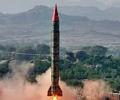
Pakistan on Wednesday tested the Hatf-V nuclear-capable ballistic missile with a range of 1,300 km, with the military saying that the launch was aimed at strengthening the country's deterrence capability.

The Agni-V can reach beyond Tibet to high-value targets in the Chinese heartland, even its northern-most provinces.

The surface-to-surface missile, a naval variant of the indigenously-developed 'Prithvi' missile, was test-fired from the ship positioned near Paradip in the Bay of Bengal at around 10.52 am, the officials said.

The missile is capable of carrying 500/100 kg of warheads and is powered by liquid propulsion twin engines.

Describing the launch of the sophisticated missile as a complete success, ITR Director M V K V Prasad said all the mission parameters were met during the trial. "The missile was randomly chosen from the production stock and the launch activities were carried out by the specially formed Strategic Force Command and monitored by scientists of Defence Research and Development Organisation as part of training exercise," sources said.
India's nuclear-capable, surface-to-surface Agni-II ballistic missile, with a strike range of 2,000 kms, was on Friday test-fired as part of user trial by the army from the Wheeler Island off Orissa coast.

The missile has a strike range of 2000 km, the sources said soon after it blasted off from a mobile launcher at the Launch Complex-4 of the Integrated Test Range, the sources said.
Pakistan on Saturday test fired two short-range ballistic missiles capable of carrying nuclear and conventional warheads and striking Indian cities, with Premier Yousuf Raza Gilani saying it was time for the world to recognise his country as an atomic power.The armed forces conducted 'training launches' of the Shaheen-I missile with a range of 650 km and the Ghaznavi missile with a range of 290 km at the conclusion of an annual field training exercise.
 © 2026 Rediff.com - Investor Information - Advertise with us - Disclaimer - Privacy Policy - Sitemap - Feedback - About us - Terms of use - Grievances