
Hometown diplomacy mixed with a Silk Road touch is expected be part of Chinese President Xi Jinping's reciprocal gesture when Prime Minister Narendra Modi visits China before end of May.
China has demonstrated that it has the power to not be isolated, and it is likely to become more powerful over time.

'Modi's recent decisions to improve India-China relations, adjust India's neighbourhood policies and to rebalance India's ties with the major powers are linked to his political agenda.' 'Of course, the good part is that this agenda is also in the national interest,' says Ambassador M K Bhadrakumar.

Thinking big, China is changing the world order; with mixed priorities, we can but tag along, writes T J S George.

China's intended role for AIIB is not so different from the existing Western lenders like the World Bank.

As India rises, creating niche areas for itself in the Asian landscape, China and India are bound to step on each other's vital areas of importance, says Srikanth Kondapalli.

The decision to not attend the forum attended by 28 heads of state and 130 national delegations is a clear break from its usual policy of going along with the crowd.

It's a packed 5-nation, 9-day, visit for Prime Minister Modi as he heads to Uzbekistan, Kazakhstan, Kyrgyzstan, Turkmenistan and Tajikistan, apart from Ufa in Russia.

'The intrusion in Chumar, during and beyond the Chinese president's visit, is unprecedented and has qualitatively changed the tone of the India-China relationship,' says Jayadeva Ranade, a member of the National Security Advisory Board.
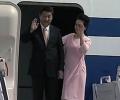
'As the first leaders of their respective countries born after Indian Independence and the Chinese Liberation, Modi and Xi would be expected to have the ability to overcome the traditional mindsets and the hierarchical nature of their official/bureaucratic establishments,' say Alka Acharya and Jabin T Jacob.

'Chinese leaders rarely receive their foreign guests in cities other than Beijing. Such respect for India!' 'Does it mean that Modi could replicate "the warmth and unconventional way" by sending Indian troops into Tibet, as Xi did in Chumur (Ladakh) when he arrived in India? Of course, Indians are far too polite to do so,' says Claude Arpi.

The developments in Af-Pak region, particularly the fall out of Pak political paralysis, would make President Xi Jinping's task a little more complicated, says Colonel R Hariharan.

'Whether it's investments in Kashmir, building naval facilities, or selling top-of-the-range military equipment, Pakistan could well benefit more under Xi's watch.' 'Do Chinese concerns about the 'Islamisation' of Pakistan give it pause about how quickly to move forward with security and economic projects? At the moment the indication is quite the opposite: China is doubling down on its support to Pakistan, partly because of its fears about where the country is headed.'
 © 2026 Rediff.com - Advertise with us - Disclaimer - Privacy Policy - Sitemap - Feedback - About us - Terms of use - Grievances