The government on Tuesday appointed three external members -- Ram Singh, Saugata Bhattacharya and Nagesh Kumar -- to the RBI's rate-setting Monetary Policy Committee for four years. The central government has reconstituted the Monetary Policy Committee (MPC) of RBI, the finance ministry said in a statement. Ram Singh is the director of the Delhi School of Economics, Saugata Bhattacharya is an economist, and Nagesh Kumar is the director and Chief Executive, Institute for Studies in Industrial Development, New Delhi.

An audit should determine whether a voluntary retirement scheme should be offered or staff redeployed or manpower strength slashed.

A five-member committee, headed by IIM-Ahmedabad's Prof Ravindra H Dholakia, was set up by Civil Aviation Minister Ajit Singh after a review meeting of the ailing national carrier's functioning.

Wednesday's was the first MPC meeting that had a dissent note.
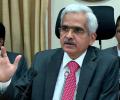
Das favoured shifting the stance of monetary policy from neutral to accommodative to send a clear signal, indicating that more measures could be taken in the near future to boost growth.

The 6-member Monetary Policy Committee, headed by Reserve Bank of India Governor Urjit Patel, in its fifth bi-monthly review, kept the repo rate unchanged at 6 per cent and reverse repo at 5.75 per cent.

Although there is headroom for further monetary policy action, at this juncture it is important to keep our arsenal dry and use it judiciously: RBI's Das.
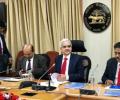
The fourth consecutive rate cut is expected to lower equated monthly instalments (EMIs) for home and auto buyers, and borrowing cost for corporate.
All-out efforts are needed to mitigate the adverse impact of the Covid-19 pandemic, and the RBI will use any instrument necessary to revive growth and preserve financial stability, according to the minutes of the central bank's policy meeting.
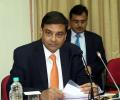
Relations between the Mint Road and North Block have often been frosty, with the former's calls for lowering rates being the biggest point of difference

RBI said at the current juncture, the all-out effort is to maintain and sustain, with the hope that when life is secure, resources, energy and time can be marshalled to rebuild and revive.

Deficits could come under more pressure in coming years as states implement their own Pay Commissions.

If banks cannot charge interest from borrowers during the moratorium, who will bear that cost? Should the depositors subsidise the borrowers by foregoing interest on deposits? In that case, we will turn banking on its head! notes Tamal Bandyopadhyay.
As the MPC is mandated to target CPI inflation rate at 4 plus minus 2 per cent, any measurement error in CPI is likely to have grave consequences for monetary policy.

RBI said inflation in the second half of the current fiscal is projected at 2.7-3.2%. It retained its GDP forecast for the current fiscal at 7.4%
Chetan Ghate, Pami Dua and Ravindra Dholakia have been appointed for 4 years

The banking sector in India is reeling under Rs 8 lakh crore of non performing assets (NPAs) or bad loans, of which PSU banks alone account for over Rs 6 lakh crore.
Headed by Urjit Patel, MPC for the fourth straight time kept the repo rate unchanged, at which it lends to the banks, at 6.25 per cent. The reverse repo, at which RBI borrows, will be 6 per cent.
 © 2026 Rediff.com - Advertise with us - Disclaimer - Privacy Policy - Sitemap - Feedback - About us - Terms of use - Grievances