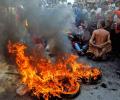
Glimpses of the protests against the $500 million United States infrastructure grant near the Nepalese parliament in Kathmandu.

Much to the surprise of Beijing, Nepal's Parliament on Sunday ratified the contentious US-funded $500 million Millennium Challenge Corporation compact along with an interpretive declaration a day ahead of the February 28 deadline set by Washington.

Nepal witnessed political turbulence in 2022 that dramatically turned rivals into allies and throned former guerrilla leader Pushpa Kamal Dahal 'Prachanda' as the prime minister for a third time, as Kathmandu made efforts to balance ties with immediate neighbours India and China with high-profile talks and visits.

The ministry of external affairs said the artificial enlargement of territorial claims by Nepal is not based on historical facts or evidence.
A house meeting has been scheduled for Saturday as per the Parliament's notice and the matter relating to the constitution amendment bill is likely to come during the meeting, parliamentary sources said. Meanwhile, in a conciliatory tone, India on Thursday said it deeply values its friendly ties with Nepal.

Prime Minister Narendra Modi will address the Nepalese Parliament and offer prayers at the famed fifth-century Pashupatinath Hindu temple during his first visit to the country from August 3.
He claimed that India built a Kali temple, created 'an artificial Kali river' and 'encroached the Nepalese territory through deploying the Army' at Kalapani. The river defines the border between the two countries.

The Committee has asked the UPA government to stop arms supply to Nepal and not do anything to legitimise the king's "authoritarianism".
Nepal last month released the revised political and administrative map of the country laying claim over the strategically key areas, more than six months after India published a new map in November 2019.

According to India's assessment, the release of the new political map by Nepal and obtaining a legal backing to it from the lower house of Nepalese Parliament were part of a "myopic" agenda to gain mileage in domestic politics.
 © 2026 Rediff.com - Advertise with us - Disclaimer - Privacy Policy - Sitemap - Feedback - About us - Terms of use - Grievances