
India clarified its absence from a South Africa-initiated naval wargame, stating it was not an institutional BRICS activity. The exercise involved navies from China, Russia, Iran, and others, amid rising tensions in Iran.

In a year bookended by intractable conflicts and geopolitical fragmentation, India focused on ramping up military prowess by broadly firming up defence procurement worth Rs 4.22 lakh crore even as Indian and Chinese militaries completed pulling back their troops from border face-off points in eastern Ladakh.

The Philippines Navy this month alleged that the Chinese ships used water cannons to attack its ships.

The navy has deployed surveillance aircraft and ships to locate the missing pilot.

While the first phase of the 24th edition of the Malabar exercise was conducted in Bay of Bengal from November 3-6, the second phase was conducted in the Arabian Sea from November 17-20, said a statement by the Indian Navy.
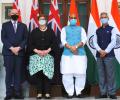
India and Australia on Saturday decided to expand military engagements across services and facilitate greater sharing of critical information in line with their resolve to significantly expand strategic ties.
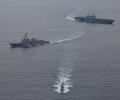
The first phase of the Malabar exercises is due to begin in the Bay of Bengal off Visakhapatnam coast on Tuesday and end on November 6. The second phase of the mega exercise is scheduled to be held from November 17 to 20 in the Arabian sea.

Australian foreign minister Marise Payne and defence minister Peter Dutton will visit India from September 10 to 12 to take part in the dialogue with their Indian counterparts.
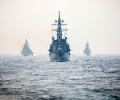
Aircraft carriers of India, the United States, Japan and Australia are set to take part in the second phase of Exercise Malabar that is scheduled to take place from November 17 to 20 in the Indian Ocean region, the Navy said on Monday.

We do not know, because there has been no discussion, no transparency and most likely no real thinking on this matter at our end, observes Aakar Patel.
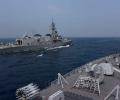
The navies of India, the US, Japan and Australia on Tuesday held a series of complex manoeuvres in the Bay of Bengal, kick-starting the four-day-long first phase of the Malabar naval exercise, seen as a prelude to future military cooperation among the member nations of the Quad or Quadrilateral Coalition.

India's decision to heed to Australia's request to be part of the mega naval drill comes in the midst of growing strain in ties with China over the border row in eastern Ladakh.
'Any future course of action towards active participation in the alliance when formed would need a lot of deliberation, long term vision and should be in our best national interests,' notes Commodore Vengalil Venugopal (retd).

The exercise is taking place at a time India and China are locked in a nearly six-month-long bitter border standoff in eastern Ladakh that has significantly strained their ties.

India cannot choose its geography and devise regional strategies to dovetail into the Western Indian Ocean hypothesis conceived in the Pentagon, argues Ambassador M K Bhadrakumar.
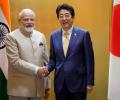
With the signing of the pact, the Quad grouping of India, Japan, Australia and the US is set to gain more heft now, notes Dr Rajaram Panda.

Notwithstanding the strain in ties, the navies of India and China carried out a well coordinated operation to rescue a merchant ship in the Gulf of Aden which was hijacked by Somali pirates on Saturday night.

Malabar 2011 is the latest in a continuing series of exercises conducted to advance multinational maritime relationships and mutual security issues.
Notwithstanding fears of a tsunami following a powerful earthquake off Indonesia on Wednesday, the navies of India and the United States carried out their joint exercises off the coast of Chennai.
China on Wednesday expressed its "heartfelt gratitude" to the navies of India, the United States and Turkey for their efforts in saving 24 Chinese sailors from falling into the hands of Somali pirates and said international community should work more closely in fighting sea menace.
The navies of India and Indonesia are launching the 14th coordinated patrolling on the waters of Indian Ocean, to prevent piracy, armed robberies, poaching, illegal immigration, drug trafficking, and other illegal activities in the deep sea.

Navies of India and France recently took part in a joint exercise aimed at enhancing interoperability between the two navies.
Though Mukherjee did not specify a date for the naval exercise, sources told PTI that it will be held in April.
Vice Admiral Raman P Suthan and the commanding officers of INS Rana and INS Ranjit met Chinese North Sea Fleet Commander Rear Admiral Su Shiliang and Qingdao Vice Mayor Zeng Aimin.
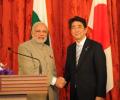
India and Japan are natural partners at sea, and Narendra Modi's recent visit underlined the need to keep the association going

China's South China Sea build-up and 'territorial sea' construct potentially affects 55 percent of Indian trade passing through the region. Hence, coordinating with the US and Japan could provide dividends to India in the longer run,' says Srikanth Kondapalli.
 © 2026 Rediff.com - Advertise with us - Disclaimer - Privacy Policy - Sitemap - Feedback - About us - Terms of use - Grievances