
The Nascent Information Technology Employees Senate (NITES) has written to the labour and employment ministry accusing global Information Technology (IT) firm Wipro of delaying onboarding of about 250 engineering graduates even though commitments were made by the company through offer letters and formal communication.

In a double-dose bid to boost growth and employment prospects, the Union Cabinet on Tuesday approved a Rs 2.07 trillion outlay for a research development and innovation (RDI) Scheme to fund private sector innovations, and an employment-linked incentive (ELI) to create over 35 million new jobs over the next two years.

A BJP leader in Uttar Pradesh has sparked controversy by suggesting that Muslim men cover themselves with tarpaulins to avoid being sprinkled with colors on Holi. The remarks, made by Raghuraj Singh, come days after a police officer in Sambhal made similar comments. The festival of Holi coincides with the second Friday of the month of Ramzan this year, leading to concerns about potential clashes. The controversy has fueled tensions between Hindu and Muslim communities in the state, highlighting the sensitive nature of religious festivals in India.

The active cases comprise 2.04 per cent of the total infections.

The Centre has taken a major step towards increasing efficiency in decision-making by empowering joint secretaries to report to secretaries directly, officials said on Wednesday.

The labour ministry has made public a list of 60 officers -- essentially labour commissioners in 20 regions across the country -- along with their e-mail address and contact numbers. They will deal with distress calls from workers who are working under the 'central sphere'.
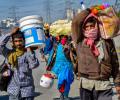
The portal, which has been tentatively named by the labour and employment ministry as the National Portal for COVID-19 Affected Unorganised Migrant Workers, will gather the details of all the unorganised sector workers who are stranded in relief camps, residential or industrial clusters.

A senior official in the central labour commissioner's office said the efforts of the government were to resolve the cases amicably and not to press for legal action against employers. "Everyone is going through tough times. We could initiate legal action if we want but that's not the idea. We want to address the issues amicably," the official said.

The country came to a virtual stand-still when trade unions called a two-day general strike on February 20 pressing for implementation of their 10-point charter of demands.

Apart from Bihar, Chhattisgarh and Jharkhand, where none of the estimated 6.7 million construction workers got cash transfer benefits, the coverage of the construction workers was the lowest in Delhi, where only about 5 per cent of the estimated workers received cash under the PMGKY, followed by Kerala and Uttar Pradesh (22 per cent), among major states. In India, construction workers belong to the unorganised sector but account for the highest share of non-farm jobs after manufacturing.

According to draft Code on Social Security, 2019, gig and platform workers will be entitled to life and disability cover, health and maternity benefits, among others.
Reaching out to the working class, especially in the unorganised sector, the government rolled out several measures in 2011, raising minimum daily wages, enlarging health insurance coverage and also notifying Majithia Wage Board recommendations for newspaper and news agency employees.

At the 47th ILC, scheduled for February 26 and 27 in Delhi, trade unions and employers were to discuss key issues related to employment and social security coverage to workers

The Labour and Employment Ministry has requested the Finance Ministry to keep Employee State Insurance and Employee State Insurance schemes out of the ambit of service tax as they are social security schemes.

Labour ministry guidelines say workers returning to cities must get housing, health insurance, facemasks. The Centre has also asked states to issue guidelines to employers to take care of the needs of migrant workers.

During this period, employment increased in almost all sectors except transport, which saw a marginal decline, according to the Labour Bureau, under the labour and employment ministry.
A positive outcome in the year was when India signed an ILO-sponsored 'jobs pact' in July and put employment and social protection at the centre of crises responses.

The EPFO had decided that 8.15 per cent interest from its debt income would be credited immediately and the remaining 0.35 per cent capital gains from the equity sale would be given later, subject to its redemption.

The norms, say industry experts, are not sufficient to weed out fly-by-night contractors.
At present, the EPFO is mandated to invest 20-45 per cent of its incremental funds - of around Rs 1.5 trillion - in debt-related instruments.

The law was amended to bring parity between public and private sector employees (including PSUs) after the gratuity limit was raised for central government on similar lines
In a bid to check industrial unrest, the government on Friday extended "the public utility service" status of the coal industry till December 17.

The NDA govt launched the Mudra scheme to give unsecured loans of up to Rs 10 lakh to small enterprises with the objective to provide self-employment

Some of the violations that will lead to community service include failure to pay social security contribution of workers, maintain records, furnish information to inspectors, pay gratuity to workers, provide crche facility and medical pay, and retrenching women workers during maternity leave.

The remaining 0.35 per cent will be credited in December this year, if the EPFO is able to redeem its equity investments.

Private firms will have to maintain a minimum net addition to their workforce each month from October this year to June 2021 to get the Employees' Provident Fund subsidy for the new recruits.

Sitharaman, who was holding the Commerce portfolio (Independent charge), was on Sunday promoted to the Cabinet rank as was Goyal.

Experts say, these leave many matters to the discretionary powers of bureaucrats, rather than providing them explicitly in the rules.

Parliamentary standing committee on labour, led by Biju Janata Dal MP Bhartruhari Mahtab, has said in its report that it is unjustifiable for owners to pay workers' wages during natural calamities.

In the draft rules, among 681 listed professions, armed security guards, supervisors, surveyors, and carpenters (class I) are proposed to be treated as highly skilled professionals; electricians, tailors and drivers are skilled; cooks and cobblers as semi-skilled and dairy coolies, office peons and sweepers as unskilled.

The government further defended its move to introduce fixed-term employment, insisting that the present system of hiring workers through contractors is exploitative.

The scheme, which will be effective from July 1, 2019 would benefit 36 million employees and 1.28 million employers. The ESI Act applies to factories with 10 or more workers and provides for medical, cash, maternity, disability and dependent benefits to employees drawing a salary of up to Rs 21,000 per month.

The 15% invested every month in equity would be allotted to subscribers in the form of units.

Under the New Code on Wages Bill 2019, employers will be required to give the minimum wages, notified by either the state or the Centre, to the unorganised sector, too.

ILO acts upon a plea by 10 central trade unions objecting to the ordinances proposed to temporarily scrap labour laws in Uttar Pradesh and Gujarat, along with executive orders issued by at least 10 states to increase the daily working limit to 12 hours from eight hours, along with other labour law changes.

According to the law, the contribution "should not be more than 5 per cent of the amount paid to gig workers. The government is likely to start seeking contribution from gig companies towards the fund from April 1, 2021.
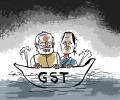
Retaining the GST rate assumes importance since states are under pressure to increase their revenues, hit hard by lockdown. Also, the Centre has not fully compensated states for their revenue losses on account of GST for 2019-20.
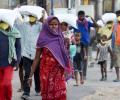
The Union home ministry and the labour ministry have asked state governments to coordinate with the chief labour commissioner's (CLC's) office to give a comprehensive data of all the migrant workers by April 11.

After assuming power in 2014 with a full majority of its own, the BJP-led NDA government started an ambitious process of reforming labour laws in the form of codes aimed at making the framework less cumbersome with a variety of alterations. It had planned four codes each for industrial relations, wages, social security and welfare, and occupational safety, health and working conditions. To this end, 35 central labour laws were to be converted into four codes that would have had the virtue of streamlining labour relations. But none of the proposed code Bills could be converted into a law principally because neither trade unions nor industry representatives came on board. They hold the key to India's low-growth-high unemployment paradigm but the government may struggle to push them through this time as well. Somesh Jha explains why
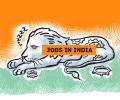
Most economists were of the view that the NSSO should release the data, as any move to withhold it will dent the image of country's statistical system.
 © 2026 Rediff.com - Advertise with us - Disclaimer - Privacy Policy - Sitemap - Feedback - About us - Terms of use - Grievances