
The government plans to introduce three bills in Parliament to address the removal of a prime minister, Union minister, chief minister, or minister of a Union Territory when arrested or detained on serious criminal charges.

The Lok Sabha witnessed chaotic scenes as opposition members protested the introduction of three draft laws, leading to torn bills, sloganeering, and adjournments.

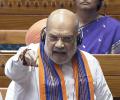
Union Minister Amit Shah on Wednesday introduced three Bills in Lok Sabha for the removal of prime minister, chief ministers and ministers arrested on serious criminal charges for 30 days, drawing fierce protests from the Opposition as the draft laws were referred to a Joint Committee of Parliament. Three House marshals formed a protective ring around Shah. Even after the House was adjourned, the Opposition members continued with the sloganeering.
'Anyone they don't like can be potentially arrested and thrown in jail for 30 days to induce regime change.'

Union Home Minister Amit Shah introduced bills in Lok Sabha addressing the removal of arrested PMs, CMs, and ministers, sparking opposition protests. Shah emphasized the need for public decision on whether leaders should govern from jail, criticizing the Congress party's stance on the matter.

Rijiju also hit out at Congress leader Rahul Gandhi, saying that his own party MPs "get uncomfortable" when he speaks in Parliament and are apprehensive that he will do "anap-shanap baatein" and the party will have to bear the consequences.
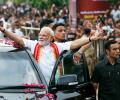
'Non-BJP state governments and their leaders, navigating today's political landscape, know well they have no clue what awaits around the corner.' 'The chances of charges pressed and oneself getting parked in custody play out on an uneven playing field,' points out Shyam G Menon.

The National Conference-Congress alliance won the recent Jammu and Kashmir assembly elections and is set to form the government. NC vice president Omar Abdullah will be the next chief minister of Jammu and Kashmir.
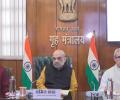
In a significant administrative reshuffle, Jammu and Kashmir Lieutenant Governor Manoj Sinha ordered the transfer and posting of 48 J-K Administrative Service (JKAS) officers, potentially creating friction with the National Conference-led government in the Union Territory. The move, seen by many as an attempt by the LG to assert control over the bureaucracy, includes the transfer of 14 additional deputy commissioners and 26 sub-divisional magistrates. The timing of the order, coinciding with the elected government's wait for approval on business rules, raises concerns over power dynamics in the region.
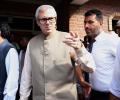
The strong statement from Union Home Minister Amit Shah's office came after former Jammu and Kashmir chief minister Omar Abdullah asked bureaucrats in the Union Territory to resist any pressure to "further disempower" the incoming elected government.
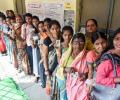
The ruling Bharatiya Janata Party on Thursday took a major step to implement its key plank of "one nation, one election" as the Union Cabinet headed by Prime Minister Narendra Modi approved the constitutional amendment bill to roll out the concept of simultaneous Lok Sabha and state assembly polls, sources said.
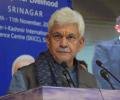
Lieutenant Governor Manoj Sinha's power to nominate five members to the Jammu and Kashmir Assembly was at the centre of a political and legal debate on the eve of vote count, with the Congress and regional parties the National Conference and the People's Democratic Party on Monday opposing any such move during government formation.

The proposed first constitutional amendment bill would deal with making provisions for holding Lok Sabha and state legislative assembly elections together.

He will succeed incumbent Rajiv Gauba, who completes his unprecedented five-year term in the top bureaucratic post this month-end.

All parties in Jammu and Kashmir said the assembly election should be held with the parliamentary polls, but the entire administrative machinery said it cannot be done simultaneously

The Supreme Court on Tuesday reserved its verdict on a batch of pleas challenging the abrogation of Article 370 of the Constitution which bestowed special status on the erstwhile state of Jammu and Kashmir.

People's Democratic Party president Mehbooba Mufti and several other regional party leaders on Monday claimed that they have been placed under house arrest on the fifth anniversary of the reading down of Article 370 of the Constitution that provided special status to Jammu and Kashmir.

According to the cause list for December 11, Monday, uploaded on the apex court website, a five-judge constitution bench headed by Chief Justice D Y Chandrachud would deliver the verdict.

The Supreme Court on Wednesday asked whether Parliament could have enacted the Jammu and Kashmir Reorganisation Act, which divided the erstwhile state into two Union territories, during the subsistence of President's rule in 2018-2019.
'Everyone is unhappy with the lieutenant governor's administration, which is ignorant, high-handed, and inaccessible.'

Six bills, including the one to amend the Jammu and Kashmir Reorganisation Act, were introduced in the Lok Sabha on Wednesday amid protests by opposition members over the violence in Manipur.

The L-G will take decisions on police, officers of all-India services such as the IAS and the IPS, and giving sanction for prosecution in various cases.

He asserted that the concept of 'one flag, one prime minister, one Constitution' was not a political slogan and the Bharatiya Janata Party firmly believes in the principle and finally implemented it with regard to Jammu and Kashmir.

The 14-member delegation of the Apex Body Leh and Kargil Democratic Alliance met the high-powered committee for Ladakh headed by Minister of State for Home Affairs Nityanand Rai.
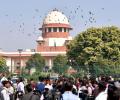
Chief Justice Chandrachud said the court will allow the lead counsel from the petitioner's side to argue on all aspects and rest of the counsel can add on certain aspects, so that there are no overlapping arguments.
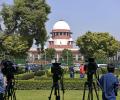
Was the decision taken by the Centre on August 5, 2019 to abrogate the provisions of Article 370 of the Constitution, which bestowed a special status on the erstwhile state of Jammu and Kashmir, constitutionally valid? The Supreme Court is scheduled to pronounce its verdict on Monday on a batch of petitions challenging the abrogation of the provisions of Article 370.

Union Home Minister Amit Shah on Wednesday blamed India's first Prime Minister Jawaharlal Nehru's "two major blunders" -- declaring a ceasefire without winning the entire Kashmir and taking the issue to the United Nations -- for the sufferings of the people of Jammu and Kashmir.

Besides the bills, the government has listed the first batch of supplementary demands for grants for 2023-24 for presentation, discussion and voting during the session.

With the completion of this third extension, Rajiv Gauba will become the longest serving cabinet secretary of the country. Till now, B D Pande had been the longest serving cabinet secretary from November 2, 1972, to March 31, 1977.
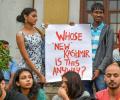
The Supreme Court on Monday dismissed a petition seeking a declaration that abrogation of Article 370 of the Constitution, which bestowed special status on the erstwhile state of Jammu and Kashmir, was constitutionally valid.

The ministry said the high powered committee for Ladakh headed by Minister of State for Home Nityanand Rai has been working actively with representatives of the ABL and the KDA and significant progress has been made.

National Conference leader Mohammed Akbar Lone on Tuesday filed an affidavit in the Supreme Court reiterating his oath as Lok Sabha MP, saying he will preserve and uphold the Constitution and protect the country's territorial integrity, an undertaking that irked the Centre which claimed it added "insult to injury to the nation".
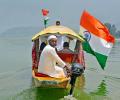
The Supreme Court on Tuesday termed as "unacceptable" the submission that Article 370 of the Constitution ceased to operate once the term of the constituent assembly of Jammu and Kashmir ended in 1957 after drafting the state's constitution.
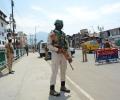
The central government's response was conveyed to the court by Solicitor General Tushar Mehta, after a five-judge constitution bench headed by Chief Justice DY Chandrachud, hearing the pleas challenging the abrogation of Article 370, asked it to set a specific time frame for restoration of electoral democracy in the erstwhile state.
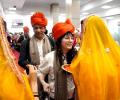
Defending the abrogation of Article 370 of the Constitution, the Centre on Monday told the Supreme Court that the entire region of Jammu and Kashmir has witnessed an "unprecedented" era of peace, progress and prosperity, with street violence, orchestrated by terrorists and secessionist networks, becoming "a thing of the past."

Article 370 of the Constitution, which bestowed special status on the erstwhile state of Jammu and Kashmir, was a 'temporary provision' and any interpretation of the provision cannot postulate that integration of J-K with India was temporary, the Supreme Court ruled on Monday.

In Hindu mythology, the 'Raghu clan', to which Lord Ram belonged, believed in the principle that you must never break your promise even if you have to lose your life keeping it.

Gauba is said to be the key architect of the Jammu and Kashmir Reorganisation Act under which Jammu and Kashmir was divided into two Union territories following the abrogation of the special status given to the erstwhile state under Article 370 of the Constitution.
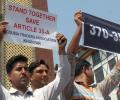
Several petitions challenging the Centre's decision to abrogate the provisions of Article 370 and the Jammu and Kashmir Reorganisation Act, 2019, which split J-K into two Union Territories Jammu and Kashmir, and Ladakh were referred to a constitution bench in 2019.
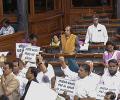
The monsoon session of Parliament which saw many disruptions since it began on July 20 over the Manipur violence issue, is set to become more turbulent with the government likely to introduce a bill in the Lok Sabha to replace the Delhi services ordinance.
 © 2026 Rediff.com - Advertise with us - Disclaimer - Privacy Policy - Sitemap - Feedback - About us - Terms of use - Grievances