
ISRO chairman S Somanath said the success gave the space agency "greater confidence," as the GSLV will be next deployed in the NISAR mission, a collaborative effort with the US' NASA.

The MCF subsequently issued commands to the satellite to make the earth viewing face to orient towards earth. The calibration of the gyros on board the satellite was also carried out.

From a few rain gauges in 1875 to rivalling the world's best weather agencies, the India Meteorological Department (IMD) has weathered its way to becoming a global leader in forecasting.
Space scientists began the exercise at 8:17 am by commanding the satellite from Master Control Facility at Hassan in Karnataka

INSAT-3D, developed by the Indian Space Research Organisation and its Space Applications Centre, is designed to provide meteorological observation and monitoring of land/ocean surfaces.
All systems on board the satellite were functioning normally.
ISRO does not figure either in the main list of top 20 satellite operators or in the supplementary list of five operators that are on threshold of commercial success in a ranking done by Space News.
INSAT-4CR is similar to INSAT-4C, which was lost during the unsuccessful launch last year.
The satellite has reached its final slot and will be fully operational by the month-end.

Here are some things you must know about this significant launch and why this satellite is a big deal for India.
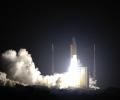
The launch of Ariane-5, which will carry India's indigenously-built 3,025 kg INSAT-4B geostationary satellite and Skynet 5A of EADS Astrium, is set for between 3.55 am and 4.28 am on Sunday.
With a mission life of ten years, INSAT-4CR will carry 12 high-power Ku-band transponders designed to provide Direct-to-Home television services, facilitating video picture transmission and digital satellite news gathering.

The Insat-4B communication satellite has been hit by a 'power supply anomaly' in one of its two solar panels, partially affecting some television and telecom services in the country.
Though it was originally intended to be the last launch for the INSAT 4B by Arianespace with the future satellites planned for launch from the Satish Dhawan Spaceport in Sriharikota, India is expected to launch INSAT 4G from an acquired launcher.
The GSLV will put into orbit the INSAT-4CR, which carries 12 high-power Ku-band transponders for direct-to-home television services, video picture transmission and digital satellite news gathering.
Industry experts say that even after the Insat-4B launch, there would be a requirement of over 25 more transponders from new players as well as older players looking for expansion.
Indian space scientists have received signals of Indian National Satellite-4A.
The most advanced and powerful fourth generation communication satellite INSAT 4A was now closer to its space home in geostationary orbit.
INSAT-4A, India's most advanced and powerful communication satellite, has been successfully placed in near geo-synchronous orbit and its solar panels and two antennae have been deployed.
The rocket is carrying two other spacecrafts, took off from Kourou, French Guyana.
K Narayana, former director of SDSC-SHAR and currently senior advisor to the Centre, will chair the 15-member panel
This is the first time ISRO was putting into orbit a two-tonne class satellite.\n\n
The anomaly was found in the 'water deluge system' that is intended to reduce the acoustics level for the safety of the launch-pad
A failure analysis committee has been set up to study the recent mishap.
Indian Space Research Organisation's immediate plan was the launch of two more PSLV flights this year and a GSLV launch early next year.

A mission to study the Sun, and launching a climate observation satellite, a test vehicle as part of Gaganyaan human space flight programme and an Indo-US synthetic aperture radar.

The launch of Polar Satellite Launch Vehicle (PSLV-C52) is scheduled at 05:59 hours on Monday from the First Launch Pad of Satish Dhawan Space Centre, Sriharikota, the Bengaluru-headquartered space agency said.

vThe longest duration cyclone over the north Indian Ocean had developed over the Bay of Bengal and weakened over the Arabian Sea between November 8-23, 1977 with a life period of 14 days and six hours.

Scientists are working on conducting various tests for the ambitious Gaganyaan mission and the agency is coordinating with the Navy and others in this connection, he said.
 © 2026 Rediff.com - Advertise with us - Disclaimer - Privacy Policy - Sitemap - Feedback - About us - Terms of use - Grievances