
A comprehensive risk assessment warns that Kishtwar district in Jammu and Kashmir faces a serious threat from glacial lake outburst floods (GLOFs), endangering lives, infrastructure, and the ecosystem. The report calls for immediate mitigation measures and long-term strategies to build resilience.
'What we are witnessing is not a freak incidence or a freak occurrence, but a new climate reality where warming oceans, monsoon variability and local geography are combining to produce extreme events.'
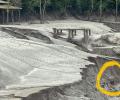
A GLOF occurred in parts of Lhonak Lake, leading to a rapid rise in water levels with very high velocities downstream along the Teesta River Basin in the early hours of October 4. This resulted in severe damage in Mangan, Gangtok, Pakyong and Namchi districts.

More than 4.5 lakh pilgrims paid their obeisance at the natural ice Shiva Lingam formation inside the cave shrine last year.

Sikkim Chief Minister Prem Singh Tamang, better known as P S Golay, on Friday said that the Himalayan state has incurred damages worth thousands of crores of rupees in the flash flood.

The NRSC satellite imagery revealed that the lake covered approximately 162.7 hectares. Its area increased to 167.4 hectares on September 28 but drastically reduced to 60.3 hectares.

A dozen teams of the NDRF will be deployed to ensure the safety of the people who embark on the yatra from July 1, they added.

A study by an international team of researchers had warned two year ago that the South Lhonak lake in Sikkim may burst in the future and significantly impact the downstream region.

'The Weather Channel argues that India faces the gravest challenge: Climate change-induced health vulnerability.' 'This is an issue often neglected, alerts Claude Arpi: "Prolonged summers, unpredictable rains, floods, droughts, and rising sea levels are the harsh realities of climate change in the country. These factors increase the frequency and severity of illnesses, pushing people into poverty, and forcing migration".'

Glaciers in the Karakoram region are in a stable condition, but those feeding the Ganga and the Brahmaputra river basins are melting at a faster rate, the earth sciences ministry has said.
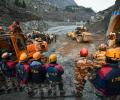
The study by an international team led by scientists at the UK's Newcastle University is the first global assessment of areas at greatest risk of Glacial Lake Outburst Floods (GLOF). Published in the journal Nature Communications on Tuesday, it estimates that 15 million people around the world are at risk from flooding caused by glacial lakes.

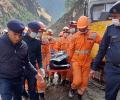
On day three after a flash flood wreaked havoc in Sikkim's Teesta basin, the number of bodies recovered from the river and mud embankments downstream rose to 22, including seven army men.
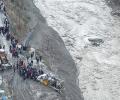
The study suggests that climate change is contributing to such events happening more frequently, and highlights risks of increasing development projects in fragile environments.

Uttarakhand Chief Minister Trivendra Singh Rawat said saving lives and extending all help to the families of the deceased is the state government's priority.
'Events like the one we saw on Sunday are complex geological processes which can be impacted by weather and climatic conditions.' 'It is difficult to attribute something like this to just one factor or to a particular time period, especially when we have still not understood the exact cause.'

'We need an early warning system in India.'
 © 2026 Rediff.com - Advertise with us - Disclaimer - Privacy Policy - Sitemap - Feedback - About us - Terms of use - Grievances