
'The unexpected turn of events and assertion of sovereignty by the Taliban has baffled the Pakistan security establishment.'

Pakistan declared an 'open war' with Afghanistan following airstrikes targeting Taliban fighters in response to alleged cross-border attacks. The situation has drawn international concern, with calls for de-escalation and diplomatic resolution.

By appearing to privilege ideological affinity over strategic balance, India risks eroding the trust painstakingly built across West Asia. Once the perception takes hold that India's friendship is conditional and transactional, rebuilding credibility will be difficult, warns Amberish K Diwanji.

Afghans have deep self-respect and are the last people to put up with humiliation. Is it any surprise that relations between Afghanistan and Pakistan have touched an all-time low and the two countries are now at war? asks M R Narayan Swamy.

'If this region destabilises, then we are not far away. This region should not destabilise.'

Pakistan launched a retaliatory operation, 'Ghazab lil Haq,' against the Afghan Taliban following alleged border attacks, resulting in reported casualties and destruction of Taliban infrastructure.

'Pakistan wanted India out of Afghanistan to which again the Taliban told Pakistan to take a walk.' 'Six months after they came back to power in 2021 India was back in Afghanistan at the request of the Taliban.' 'The Taliban realised that India has no agenda of its own in Afghanistan.'

Pakistan seized 19 Afghan military posts and "terrorist hideouts" in response to alleged attacks by Afghan forces. Kabul claims significant Pakistani casualties. Tensions escalate following repeated attacks by the Tehreek-e-Taliban Pakistan (TTP).
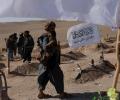
Afghanistan's Taliban forces targeted 'several points' in Pakistan on Saturday, Taliban said, days after Pakistani aircraft carried out aerial bombardments inside the country, as per Al Jazeera.
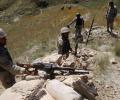
Afghan Taliban forces fired on multiple Pakistani border posts in the Upper Kurram district, killing one Frontier Constabulary (FC) soldier and injuring 11 others. The incident came after Pakistan targeted terrorist positions in Afghanistan to punish the banned Tehreek-e-Taliban (TTP) militants. Pakistani forces retaliated, inflicting heavy casualties on the Afghan side.
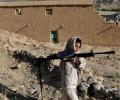
Following Pakistani airstrikes in Afghanistan's Barmal district of Paktika province, which left 46 dead and six injured, the Ministry of Foreign Affairs of Afghanistan on Wednesday summoned the Charge d'Affaires of the Pakistani Embassy in Kabul.

Pakistan, which is witnessing an influx of Tehreek-i-Taliban terrorists in significant numbers in the restive Khyber Pakhtunkhwa's tribal districts, is also facing a threat from the Islamic State (ISIS) which is trying to establish a foothold in the country, the ministry of interior has said.

The Taliban is showing its strong discontent as the high hopes given to it by the Pakistani military have been dashed, observes Ambassador M K Bhadrakumar.

The Taliban's main challenge comes on the financial and economic front and there Pakistan doesn't have the capacity to be of any meaningful help, observes Ambassador M K Bhadrakumar.
'What has the impact of 40 years of warfare in Afghanistan been on us?' 'Afghanistan is marginal to India's future.'

Internal strife and tribalism is endemic to Afghanistan, notes Colonel Anil A Athale (retd).
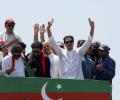
There has always been a risk-taking edge to Imran Khan. Like him or hate him, it had to be someone like him to finally threaten to demolish the Pakistani establishment, explains Shekhar Gupta.

Tahir Ali assesses the strengths, capabilities and leadership of the Haqqani network, one of the dreaded terror groups operating on both sides of the Durand Line
India should review its Kashmir policy for itself, not for others, C Christine Fair, senior political scientist, RAND Corporation, tells KS Manjunath.
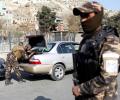
Cut off from the world and having to contend with an orthodox and repressive Taliban government, Afghans are facing the brunt of Pakistan's decades old policy of nurturing militant groups, note Harsh V Pant and Kriti M Shah four months after the Taliban took Kabul.
The ISI has achieved their desired strategic depth by creating a Pushtunistan across Af-Pak that they control. The US and India can now look forward to more 9/11s and 26/11s.

'We can't be outliers. We can't be bystanders. We have to be players.' 'The Taliban also need India to balance the winners in this game.'

The billions India invested in dams, schools, etc in Afghanistan will be gone. The Hindu and Sikh population of Afghanistan has already shrunk from some 200,000 to about 500, points out Rajeev Srinivasan.
'The India-Pakistan relationship is in a deep freeze, though it could be a lot worse had there not been a new LoC ceasefire a year ago.' 'The India-Pakistan relationship will only start to thaw if the Pakistani military decides it's prepared to push for detente.'

If the Taliban have proved one thing over these two decades, it is that they are way smarter than their big brother, observes Shekhar Gupta.

The US has the distinction of destroying a flawed but functioning State thrice since 1979. Pakistan has been their constant accomplice, explains Shekhar Gupta.

India needs to shed its policy of lethargy and inhibitions to engage the Taliban with an intent to maintain its influence in Afghanistan. This would not just put a spanner in Pakistani designs, but also incentivise the Taliban not to be the puppets of GHQ, Rawalpindi, asserts Colonel Nikhil Apte (retd), who served on the Af-Pak desk at the Military Operations Directorate.
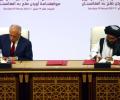
'Pakistan's trump card is that it is the only credible guarantor on the horizon who can reasonably assure the Western world that Afghanistan will not again become the revolving door for international terrorism.' 'Trust Pakistan to play this card optimally,' explains Ambassador M K Bhadrakumar.
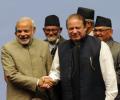
'Modi has said he has been made the PM of India not to do small things but big things. What bigger thing can there be than to have peace with Pakistan and in the neighbourhood?'

'As far as acquisition of Russian equipment is concerned, with about 70% of Indian military equipment being of Russian origin, a sudden decision to abandon imports from Russia is not feasible,' points out Brigadier S K Chatterji (retd).

'India can replicate what Pakistan did to Kulbhushan Jadhav should the need arise.' 'Hopefully, Pakistan will see reason before that transpires,' says Ambassador G Parthasarathy, former high commissioner to Pakistan.
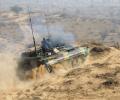
'Should the two armies clash in a conventional battlefield, the advantage will pass more and more to the Indians as the battle progresses,' says Brigadier S K Chatterji (retd).

Pakistan's prime minister is trying to use the unrest in Kashmir to save his government, says Ambassador G Parthasarathy, a former high commissioner to Islamabad.

During last week's Nuclear Security Summit, President Obama asked the media to leave and then screened videos depicting plausible scenarios pertaining to nuclear terrorism.
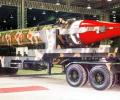
For the world and India, one of the most enduring challenges of the times is for Pakistan's nukes to be neutralised, before they are ever used by the State, their sponsored non-State actors or any rogue elements from the many terror tanzeems dotting Pakistan's unstable landscape, says Lieutenant General Kamal Davar (retd).

Can Modi and Obama forge a common outlook on international terrorism?

'The creation of Pakistan was integral to Britain's grand strategy.' 'If they were to ever leave India, Britain's military planners had made it clear that they needed to retain a foothold in the NWFP and Baluchistan because that would provide the means to retain control of Iran, Iraq, Kuwait, the UAE, Bahrain and Qatar.'

B S Prakash takes a tongue-in-cheek look at what India's neighbours think about the proposal of a SAARC satellite.

India can stay relevant in Afghanistan not by being a bystander but by actively bolstering anti-Taliban forces monetarily, militarily and politically, say Lt Gen R K Sawhney and Sushant Sareen

'Obama's decision to end the US military involvement in the Afghan civil war needs to be welcomed as a positive development for regional security and stability. India, too, has a great opportunity opening up here if it plays its cards in sync with the spirit of the times rather than continuing to view the Afghan problem in zero-sum terms,' says Ambassador M K Bhadrakumar.
 © 2026 Rediff.com - Investor Information - Advertise with us - Disclaimer - Privacy Policy - Sitemap - Feedback - About us - Terms of use - Grievances