
The Supreme Court on Friday upheld JSW Steel's Rs 19,700-crore resolution plan for debt-ridden Bhushan Power and Steel Limited (BPSL), bringing down curtains to a prolonged legal battle that spanned nearly eight years.

In a significant development, the Supreme Court on Thursday recalled its controversial May 2 verdict that had ordered liquidation of Bhushan Power & Steel Limited (BPSL) while setting aside a resolution plan of JSW Steel Limited for the ailing firm. A bench comprising Chief Justice B R Gavai and Justice Satish Chandra Sharma observed that the May 2 judgment, authored by Justice Bela M Trivedi, since retired, did not "correctly consider the legal position as has been laid down in the catena of judgments".

The Supreme Court's ruling in the BPSL case exposes deep flaws in the IBC's institutional framework and raises concern about judicial overreach, notes Rajeswari Sengupta.

Government may also consider giving relief to some of the worst-affected sectors.

The Income Tax department is understood to have detected an evasion of Rs 502 crore (Rs 5.02 billion) by two major steel manufacturers after it conducted searches and surveys against them in various parts of the country.

The Coal Ministry has issued show-cause to eight firms including Hindalco Industries and Mahanadi Coalfields, and sought explanation from five firms for delays in commencing production from mines allocated to them.

According to the Securities and Exchange Board of India regulations, if the shareholding crosses 15 per cent, it would trigger an open offer. Bhubaneshwar-based Orissa Sponge is understood to have iron ore and coal reserves of around 120 million tonnes each along with sponge iron and billet making plants.
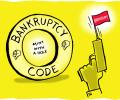
Even as lenders are getting ready to send more companies to bankruptcy courts from this week, several old cases are still awaiting resolution with no clarity on the completion of the process. This includes some high profile cases from the first list of 40 companies including Videocon Industries, Bhushan Power and Steel and Lavasa Corporation, sent by the Reserve Bank of India (RBI) for resolution. The delay is mainly due to litigation and late clarifications by various government agencies including the Reserve Bank of India and litigation by the Enforcement Directorate.

Uttam Galva Steels is a part of the Reserve Bank of India's second list of cases, which will be referred to the bankruptcy tribunal for insolvency proceedings after lenders failed to resolve the account by December 2017.

The verdict, upholding Centre's November 15, 2019, notification bringing personal guarantors of corporate debtors under the net of the IBC, assumes significance in view of the fact that various high-profile industrialists may now face insolvency proceedings along with their debt-ridden firms under the IBC.

The Reserve Bank had identified 12 accounts, each having more than Rs 5,000 crore of outstanding loans accounting for 25 per cent of total NPAs or bad loans of banks, for immediate referral for resolution under the bankruptcy law.

The delay will increase the provisioning burden on lenders and will also postpone the benefit of reversal of money set aside as provisions.

Recently, CVC suggested that banks have a monitoring mechanism for bad loan sales to ARCs, with the cash flow statement from stressed assets shared with banks.

Analysts said even though the Indian economy is expected to slow down to 7.2 per cent in fiscal 2020, it is still the best bet for investment for foreign investors.

With average capacity utilisation now touching 76 per cent, Indian companies are going back to the drawing board to add capacity but the plans to build new factories and plants are still some months away.
A total of 4,452 cases have been disposed at pre-admission stage and 66 have been resolved after adjudication. 260 cases have been ordered for liquidation.

The haircut for major banks stands at 52 per cent, if the dues of Jaypee Infrastructure, Lanco Infrastructure and Era Infrastructure are kept out of the calculation.
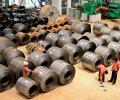
Firm terms lenders' move to appoint monitoring agency 'unwarranted'.
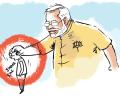
'By not only decriminalising routine business failures, but by ensuring that institutional lending and corporate rescue frameworks are strengthened via the IBC, the prime minister has ensured there is no room anymore for the proverbial 'reckless, prodigal debtor',' notes Sanju Verma.

'One by one we are seeing these private banks taking people's money and mismanaging it.' 'In the last 30 years, 30 private banks have collapsed.' 'Nationalise all banks so that people's money is safe.'

The financial year ending Saturday saw such big-ticket events that set the directional tone for the country's business journey.

Though the current National Democratic Alliance government has not endorsed the figure, it has not even repudiated it.
 © 2026 Rediff.com - Advertise with us - Disclaimer - Privacy Policy - Sitemap - Feedback - About us - Terms of use - Grievances