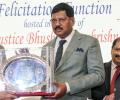
Chief Justice of India B R Gavai has said the 'trivial issue' of the protocol lapse during his visit to Mumbai on May 18 should not be blown out of proportion and the matter should be given 'quietus'.

Chief Justice of India B R Gavai on Sunday expressed his displeasure over the absence of Maharashtra's Chief Secretary, Director General of Police or the city police commissioner to receive him during his first visit to the state after being elevated to the top post.
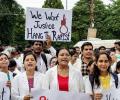
He further commented on the current state of public discourse, saying a "mob rule" is being created wherein politicians capitalise on certain incidents and assure people of the death penalty for culprits even though only the judiciary has the power to pass legal verdicts.

Justice Bobde, who decided several key cases during his tenure including the historic Ayodhya verdict, was administered oath as the 47th CJI in November 2019 and retired on Friday.

The court said people are losing jobs, while hearing a plea by lawyers seeking permission to board suburban trains.

The decision would affect the lawyers specialising in Sales Tax laws and former Sales Tax officers who work as sales tax practitioners. A bench comprising Justice H K Sema and Justice Markenday Katju while dismissing the petitions filed by the Sales Tax Practitioners Association of Maharashtra and the Bar Council of Maharashtra upholding the Bombay High Court's judgement that held only chartered or cost accountants would be eligible to certify sales tax returns.

Hailing from a family of lawyers from Maharashtra, he was part of a nine-judge Bench of the Supreme Court which in August 2017 declared the right to privacy as a fundamental right of an individual.

Justice Bobde has decided several key cases and was part of the recent historic verdict that cleared the way for the construction of a Ram Temple at the disputed site in Ayodhya.
Fed up with the treatment at the Nagpur central jail, his advocate has decided he will no longer deliver anything for Professor Saibaba, leaving it to the jail authorities to fulfill their legal responsibility to look after the professor.

Justice Ranjan Gogoi, who will demit office as the Chief Justice of India in a week's time, has etched his name in the annals of history by giving finality to one of the most politically and religiously sensitive cases, the Ayodhya land dispute, which dates back to even before the Supreme Court came into existence in 1950.
 © 2026 Rediff.com - Advertise with us - Disclaimer - Privacy Policy - Sitemap - Feedback - About us - Terms of use - Grievances