
Finance Minister Nirmala Sitharaman on Thursday said the country needs big and world-class banks, and discussions are on with the Reserve Bank and lenders in this regard.

Finance Minister Nirmala Sitharaman on Tuesday allayed apprehension that privatisation of state-owned banks would hurt financial inclusion and national interest. She said the bank nationalisation done in 1969 has not yielded the desired result as far as financial inclusion was concerned.

Exuding confidence in sustaining the tempo of credit growth, public sector bankers said on Wednesday that consolidation in the public sector bank (PSB) space has given them a robust base to scale. The privatisation of PSBs can be done through divestment of government stake to a wider base of investors without haste. There is nothing to worry about at this point (high credit offtake) as underwriting standards and risk management are much better.

The finance ministry on Wednesday allowed all private sector banks to participate in government-related business, like collection of taxes. pension payments and small savings schemes. At the moment, only few large private sector are allowed to conduct government-related business.

As per the mega consolidation plan, Oriental Bank of Commerce and United Bank of India will merge into Punjab National Bank (PNB); Syndicate Bank into Canara Bank; Andhra Bank and Corporation Bank into Union Bank of India; and Allahabad Bank into Indian Bank. Following this merger, PNB will become second largest after the SBI, Canara Bank fourth, Union Bank of India fifth and Indian Bank seventh biggest public sector lender.
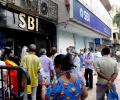
Amendments would be required in the Banking Companies (Acquisition and Transfer of Undertakings) Act, 1970 and the Banking Companies (Acquisition and Transfer of Undertakings) Act, 1980 for privatisation, sources said.

Addressing the 74th Annual General Meeting of the Indian Banks' Association (IBA), she said the industry needs to imagine how Indian banking has to be in the immediate and long-term future. As far as the long-term future is concerned, she said it is going to be largely driven by digitised processes and there is a need for seamless and interconnected digital systems for a sustainable future for the Indian banking industry.

Finance secretary Rajiv Kumar was positive in formation of a committee consisting all concerned to address the issues arising out of the proposed merger of 10 banks including preserving the identity of all the banks.
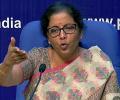
In the biggest consolidation exercise in the banking space, the government on Friday announced four major mergers of public sector banks, bringing down their total number to 12 from 27 in 2017, a move aimed at making state-owned lenders global sized banks.

All transfers and promotions for next financial year will be decided by respective banks, not by the merged entity.

Experts attribute the lower target to increased allocation under the credit guarantee scheme for small businesses. Out of the Rs 3.21 trillion worth loans sanctioned under the Pradhan Mantri Mudra Yojana (PMMY) in the last financial year, Rs 3.12 trillion were disbursed to entrepreneurs, according to official data.

'We will infuse the next tranche of recapitalisation by mid-December. Close to Rs 42,000 crore remain to be infused as capital in public sector banks in the current financial year,' a senior finance ministry official said.
Banks are also weighing the option of hiring experts for help in specialised areas.

Bank unions - officers and workmen - had buried their differences and sat across the table on August 29 to work out a fresh deal with the IBA involving a 20 per cent wage hike.

Business is down to such an extent that last year these firms could not even meet RBI's capital norm of Rs 50 million for partnerships and Rs 100 million for public and private firms in this line of business.
 © 2026 Rediff.com - Advertise with us - Disclaimer - Privacy Policy - Sitemap - Feedback - About us - Terms of use - Grievances